Community articles
Your traffic isn't the problem
I assumed the business would click once people found the site. They found it. About 5,000 of them. Two or three converted. The customers who actually…
By Baz Furby · · 5 min read
2
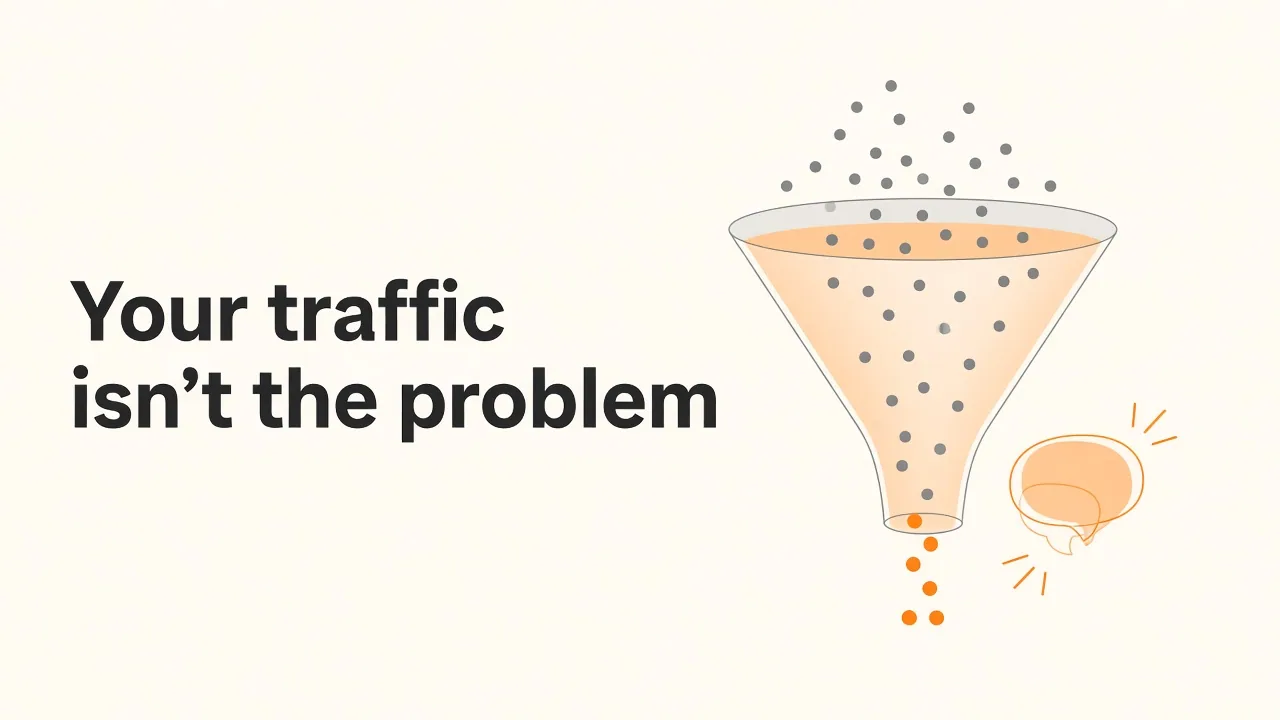
I assumed the business would click once people found the site.
They found it. About 5,000 of them. Two or three converted.
The customers who actually paid, around ten of them, came from conversations. LinkedIn messages. Chats after I spoke at conferences. People I had already been in a thread with, not people who landed on a page and sold themselves.
I post on LinkedIn every day. I have around 10,500 followers. I was not short of attention. I was short of a reason for a stranger to buy after reading a page.
The bottleneck was conversion and positioning, not traffic. If your visitor numbers look healthy and the customer list does not, start here.
Traffic feels like progress because it is easy to count
Visitor numbers go up in a neat line. Followers do too. It looks like the work is working.
A conversation does not show up in the same way. Twenty thoughtful DMs do not feel like a growth channel. A conference talk does not look like a funnel. Then you ask where the people who paid actually came from, and the graph and the customer list tell different stories.
If someone does not already understand who the product is for, what problem it solves, and why they should care now, more visitors just means more people leaving. You can pour traffic on a confused offer all year and still get two or three conversions.
The customers came from work that does not look like marketing
As a solo founder, I do the conversations myself.
I send around 20 LinkedIn DMs a day. Not a blast. A number I can actually follow up. I post every day, not to feed the site, but to give people a reason to reply, or to recognise the name when a message lands. And I speak at conferences, which is the same idea in a room: say something useful, then talk to the people who come and find you afterwards.
That is where the roughly ten customers came from. Events and LinkedIn. Not the 5,000 visits.
A website is still useful. You need somewhere to send people when they ask what you do. But in early B2B the site is a brochure, not a salesperson. The sale usually happens in a conversation, and the page either supports that or it gets in the way.
Positioning is what you hear when you talk to people
When a page does not convert, the first instinct is to tweak the headline or try a new channel. Sometimes that is right. More often, the page is repeating a sentence that only makes sense to you. You built the product, so the words feel obvious. They are not obvious to a founder who has just arrived and has no context.
You find the gap in conversation. Someone asks a question you thought the homepage already answered. Someone describes their problem in language you have never used. Someone seems interested and then goes quiet, which usually means they still cannot see themselves in the offer.
The visitor count only told me people were arriving. The conversations told me why they were leaving.
What to do this week
You do not need a new channel. You need to know where customers actually come from, and a few conversations that test whether your offer makes sense out loud.
First, write down three numbers: how many people visited recently, how many converted, and where the people who paid actually came from. Website, LinkedIn, a community, an event, a referral, a cold email. Be honest. If you cannot name the source, that is data too.
Second, take your homepage headline and say it to five people you would actually want as customers. Do not ask what they think of the copy. Ask them what they think you sell, who it is for, and whether they would know if they needed it. If two of them cannot repeat it back, the page is not the problem. The sentence is.
Third, pick 20 people who already fit, and start a conversation this week. A short, specific message. No pitch in the first note. The point is to hear how they talk about the problem, and to see whether your offer survives contact with a real person. Twenty a day is a pace I can keep as a solo founder. Twenty in a week is enough to learn something if you have been hiding behind the site.
Fourth, if you already post, treat the post as a way to start a conversation, not as a traffic source. End with a question you actually want an answer to, then follow up with the people who reply.
Fifth, after each conversation, write down one thing they misunderstood or one phrase they used that you do not use. By Friday you should have a short list. Put the best phrase on the page. Do not wait for another 5,000 visitors to tell you the old one was not landing.
Stop chasing the next 5,000 visitors
Two or three conversions from 5,000 visits is not a result I am happy with. I stopped treating that number as a reason to chase more traffic, and started treating it as a reason to get better at the conversation.
I still post every day, and I still send the DMs. I also built Grow with Ghost, an AI SDR for LinkedIn outbound, and I am the founder, but this is not a pitch for that. It is a reminder that in early B2B, conversations close. Pages, on their own, usually do not.
If your visitor graph is healthy and your customer list is not, do not start with another acquisition idea. Start with the next 20 conversations, and let those tell you what the page should have said in the first place.