Other
OddSightSeer
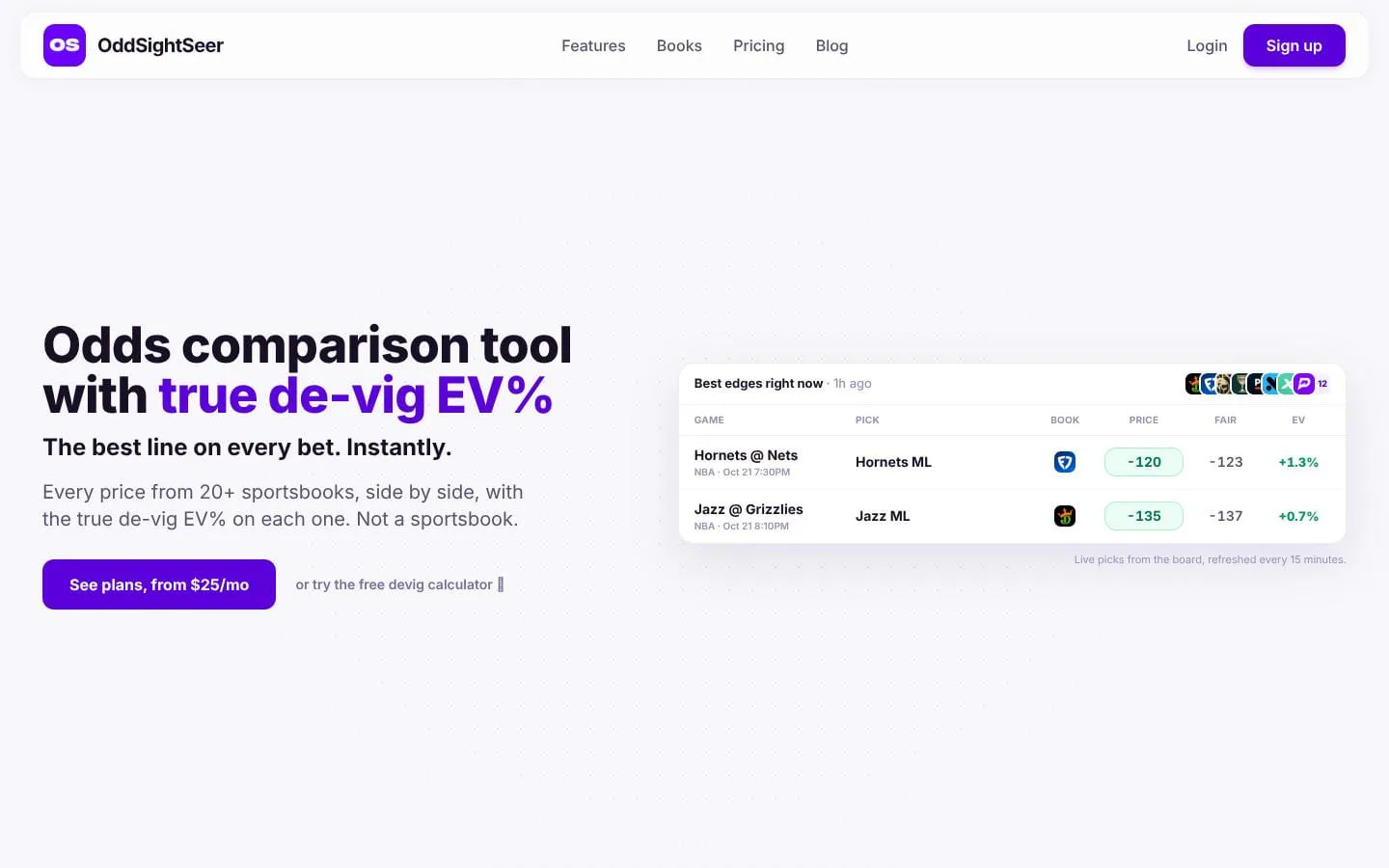
Compare sportsbook odds with de-vigged fair lines and EV%.
- Category
- Other
- Stage
- Growth
- For
- Sports bettors and DFS players seeking value bets and odds comparisons.
About
Sports data analytics platform for comparing NFL, NBA & MLB odds. Research DraftKings vs FanDuel lines, analyze +EV player props, and shop odds across 20+ sportsbooks. Not a sportsbook, informational analytics only.
Features
- Problem
- A quoted betting price includes vig and is not a direct estimate of fair probability.
- How it works
- De-vigs two-sided market prices with a power method and weights sharper sources such as Pinnacle, Novig, and ProphetX more heavily.
- Result
- Users can compare a book's offered price with a fair line and associated EV%.
- Why
- A sharp-weighted, de-vigged market price is used as the benchmark rather than an unadjusted book quote.
- Problem
- Comparing many sportsbook prices manually is slow.
- How it works
- Shows moneylines, spreads, totals, alternate lines, and period markets across 20+ sportsbooks, with the best price marked.
- Result
- Users can identify where a selected bet has the best available price.
- Why
- Prices and fair values appear on the same board row.
- Problem
- DFS pick'em payouts and flex ladders obscure the actual price of an entry.
- How it works
- Prices PrizePicks, Underdog, Pick6, Sleeper, and Dabble lines against the de-vigged sportsbook market, accounting for multipliers, flex ladders, and promotions.
- Result
- DFS players can assess fair probability and EV for pick'em entries.
- Why
- The EV calculation reflects the payout structure the user is actually offered.
- Problem
- Stake sizing and result tracking require additional calculation and recordkeeping.
- How it works
- Provides Kelly stakes, a slip builder, and a Tracker that retains the fair price at placement and automatically grades supported bets and flex entries from box scores.
- Result
- Users can size entries and monitor P/L, ROI, and average edge at bet.
- Why
- Sizing and post-bet evaluation are tied to the same fair-line methodology.
- Problem
- Arbitrage and middle opportunities can be misleading when based on non-executable exchange mid-prices.
- How it works
- Uses exchange order-book asks and available dollars for arbitrage pairs, and prices middle windows using miss cost, landing payout, and modeled landing probability.
- Result
- Users can evaluate sized arbitrage pairs and rank middles by expected value.
- Why
- The tools evaluate executable exchange prices and the economics of each pair or window.
Screenshots