Finance/Investing
Ultimate Trading System
test trading rules and prove they are not luck
- Category
- Finance/Investing
- Stage
- Mature
- For
- Systematic traders who want to test trading rules rigorously and run strategies on their own machine.
About
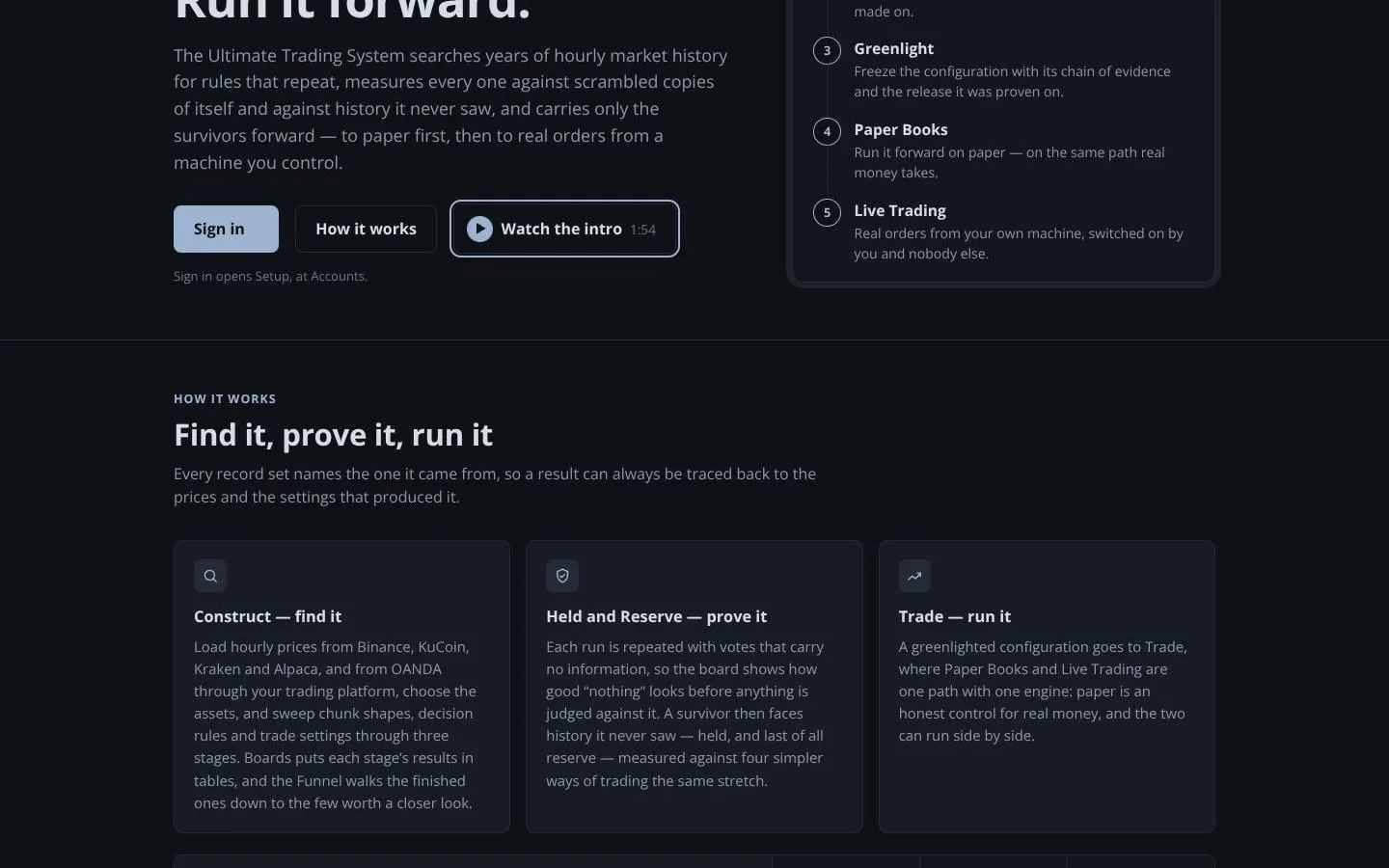
Find a trading rule, prove it is not luck, and run it forward: on paper first, then with real orders from a machine you control. Deterministic from end to end; no AI anywhere in what runs.
Features
- Problem
- A large search of settings can make it easy to find patterns that only fit the chosen history.
- How it works
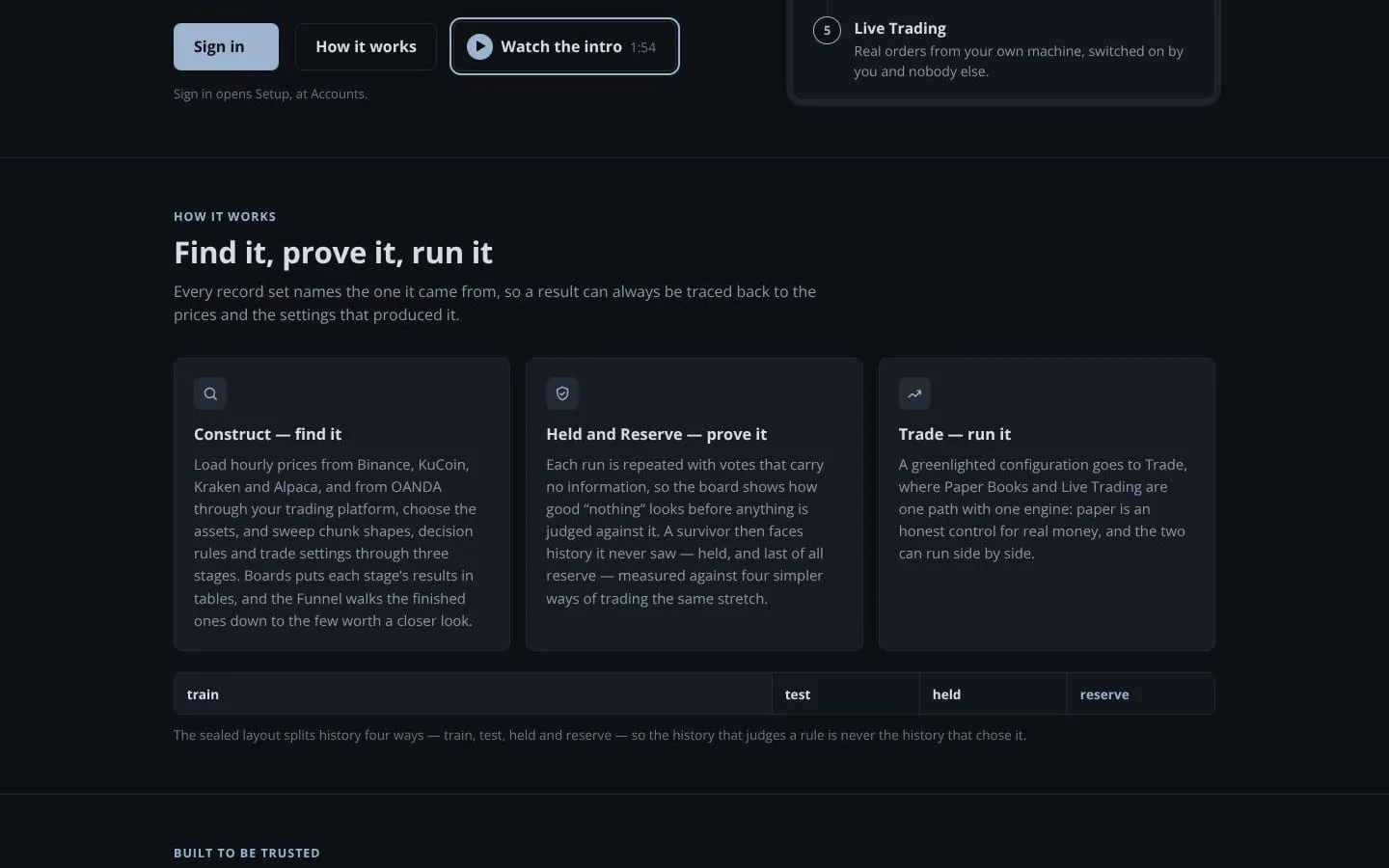
- Construct sweeps settings through three stages, with each stage producing a record set used by the next.
- Result
- Users can inspect and follow candidate rules through the Funnel, Boards, and History.
- Why
- Staged records make the search process traceable and help narrow candidates for further testing.
- Problem
- A promising result may be no better than chance or may depend on the history used to select it.
- How it works
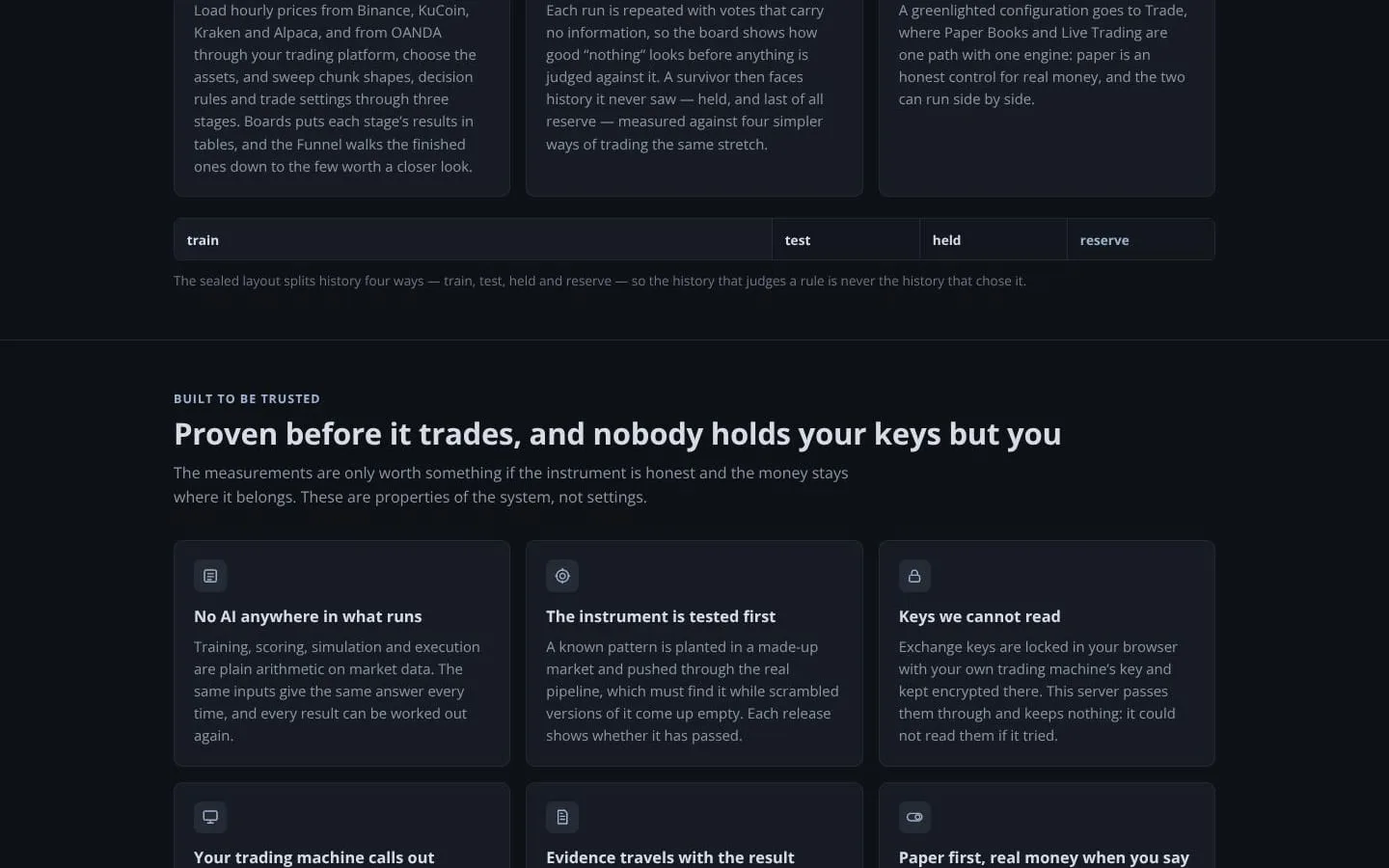
- Repeats runs with information-free votes, then evaluates survivors on held and reserve history and against four simpler trading approaches.
- Result
- Survivors receive evidence from data not used to choose them.
- Why
- Separate evaluation data and null comparisons help distinguish repeatable rules from luck and selection bias.
- Problem
- Trading results need to be reproducible and tied to the exact configuration and software release tested.
- How it works
- Greenlight freezes a configuration, its supporting record sets, and the release it was proven on; calculations are deterministic arithmetic.
- Result
- Each greenlighted configuration carries a traceable chain of evidence.
- Why
- A fixed evidence snapshot supports reproducibility and prevents results from one release being treated as validated under another.
- Problem
- Moving from research to execution can expose traders to risk before a strategy is ready.
- How it works
- Paper Books and Live Trading share one path and engine; users can paper-trade first and switch on real orders themselves.
- Result
- Users control when a strategy progresses to real orders.
- Why
- Paper trading provides a no-money-risk stage before live execution.
- Problem
- Traders may not want a service to hold their exchange keys or run their trading engine.
- How it works
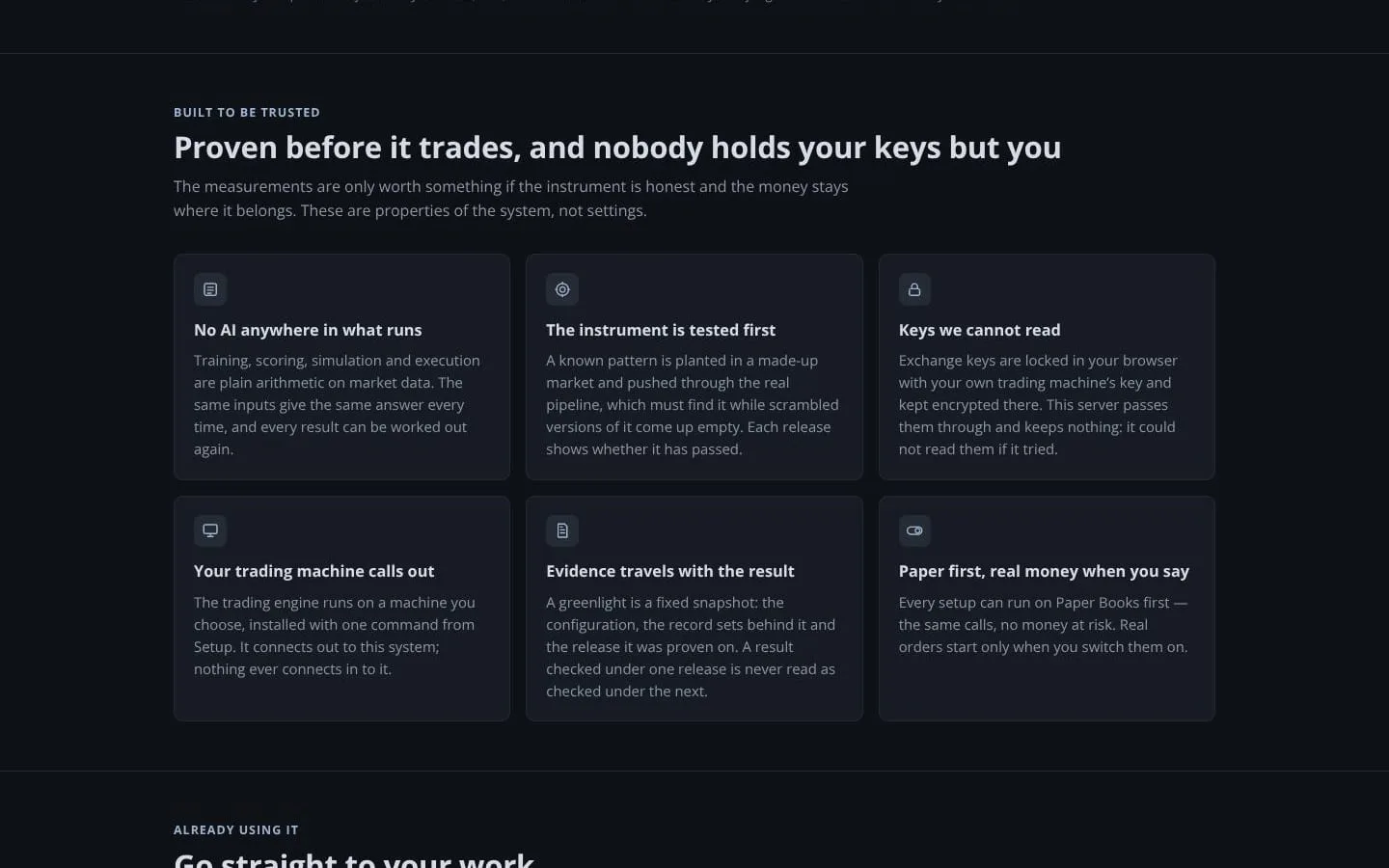
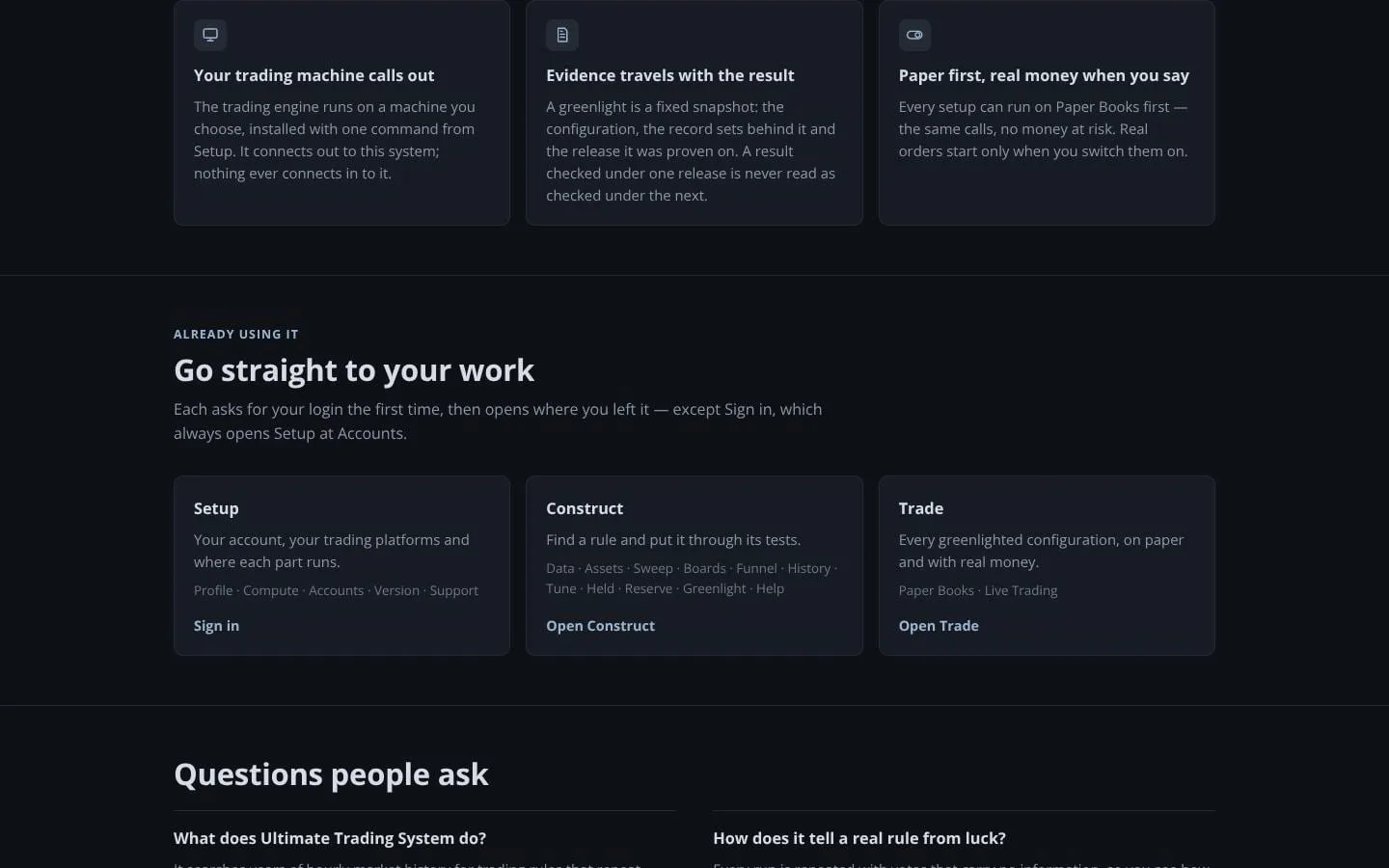
- The trading engine runs on a machine the user chooses and connects outward; keys are encrypted in the browser with that machine’s key, and the system does not hold funds.
- Result
- Users retain control over their machine, keys, and decision to trade live.
- Why
- Keeping execution on the user’s machine and restricting keys helps preserve user control.
Product questions
What does Ultimate Trading System do?
Ultimate Trading System searches hourly market history for trading rules, tests them against randomized null cases and unseen data, then lets users paper-trade or place real orders from a machine they control.
Who is Ultimate Trading System for?
Systematic traders who want to test trading rules rigorously and run strategies on their own machine.
Screenshots