Productivity
WhichNotes
Turn scattered sources into living, traceable research.
- Category
- Productivity
- Stage
- Beta
- For
- Researchers, analysts, writers, students, and small research-heavy teams working across multiple sources.
- Platforms
- Web
- Pricing
- Free plan available. Personal Premium is $4.99/month. Teams are $4.99/seat/month with a 2-seat minimum. 7-day trial available.
About
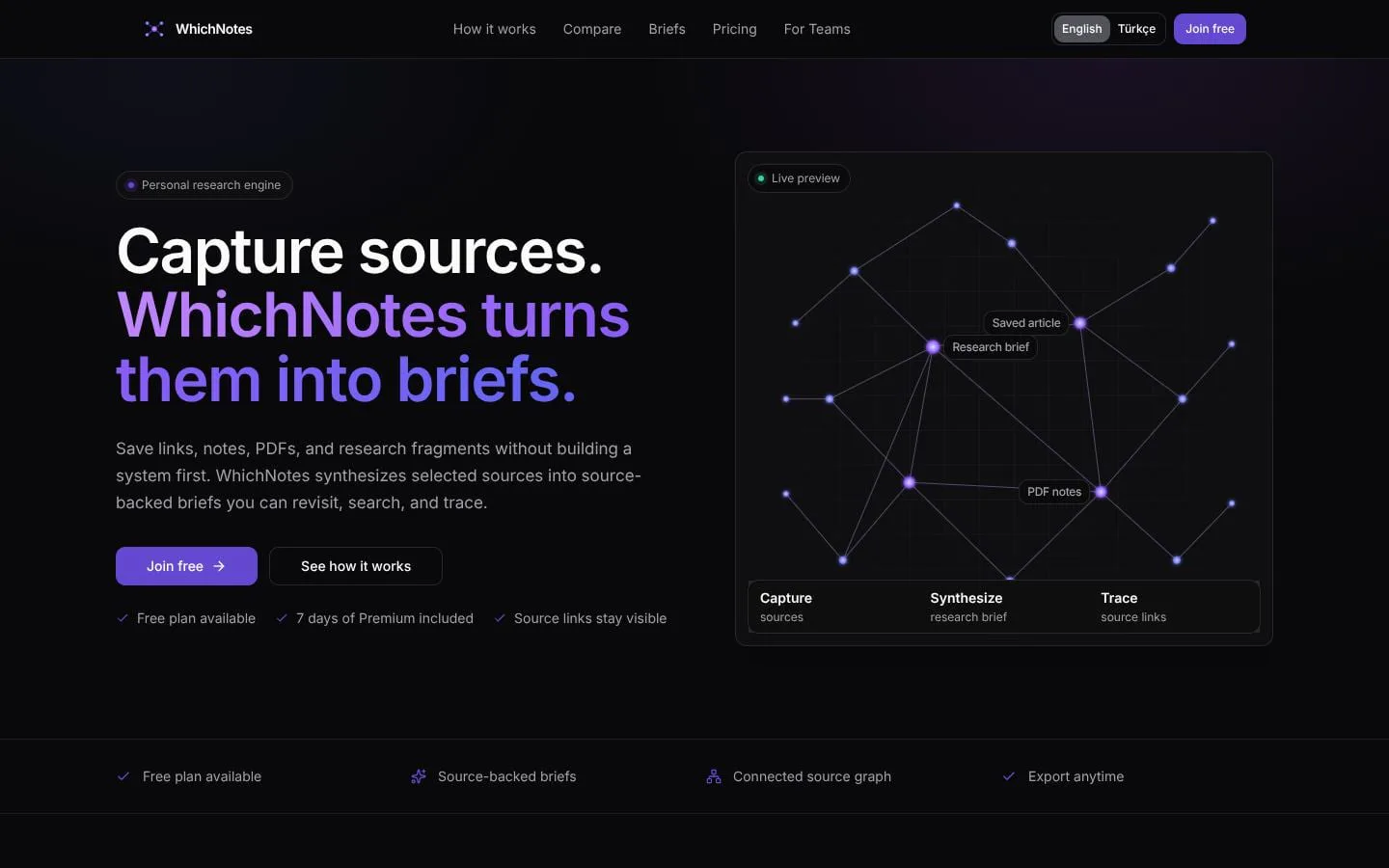
WhichNotes turns notes, links, PDFs, and research fragments into source-backed Living Briefs and traceable answers. It keeps sources, claims, and related context connected so research can evolve without losing the evidence behind it.
Use cases
- Competitor and market research
- Literature and academic research
- Product discovery and customer research
- Decision and investment memos
- Turning collected sources into evolving research briefs
Features
- Problem
- Research arrives in varied formats and is cumbersome to organize upfront.
- How it works
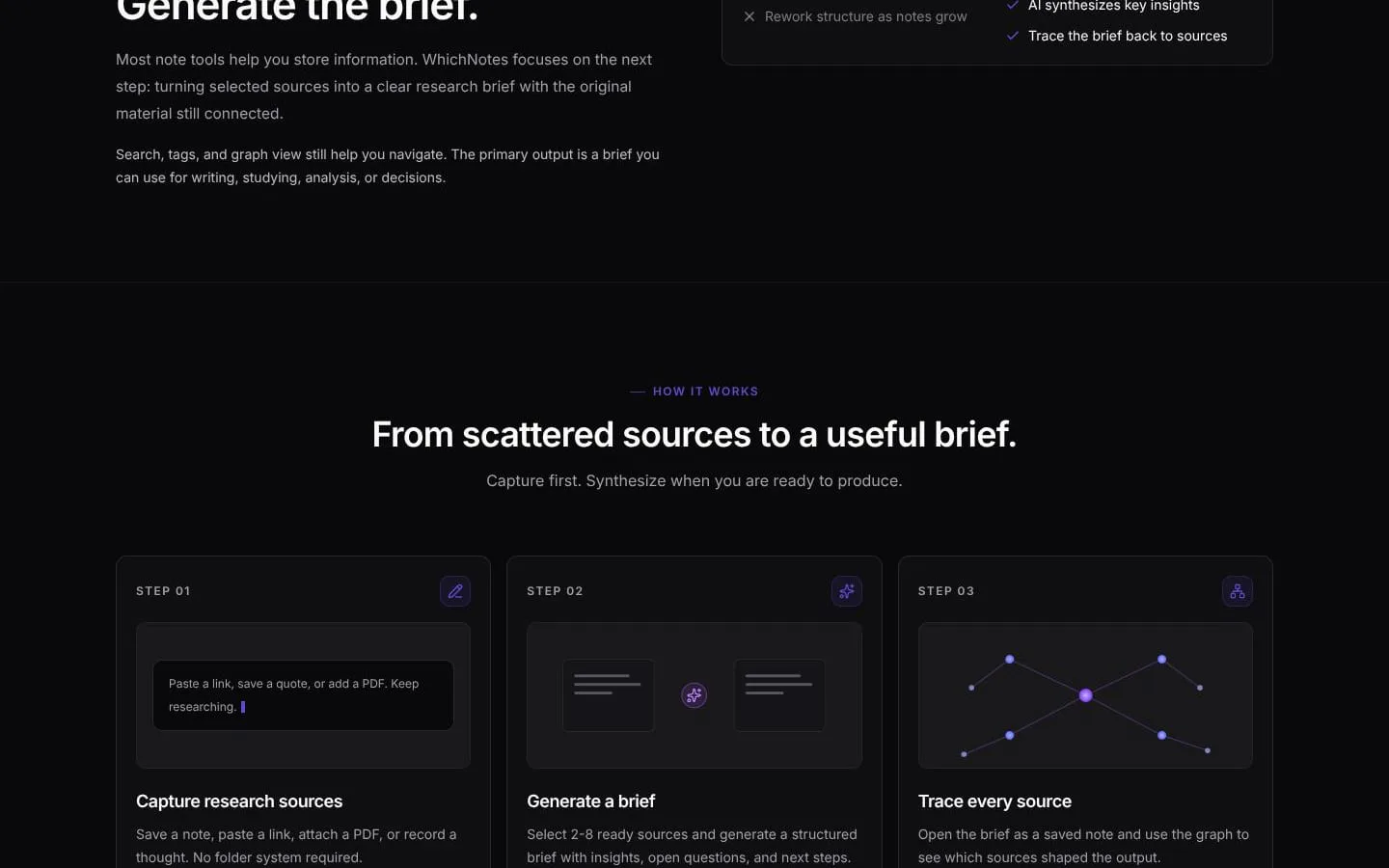
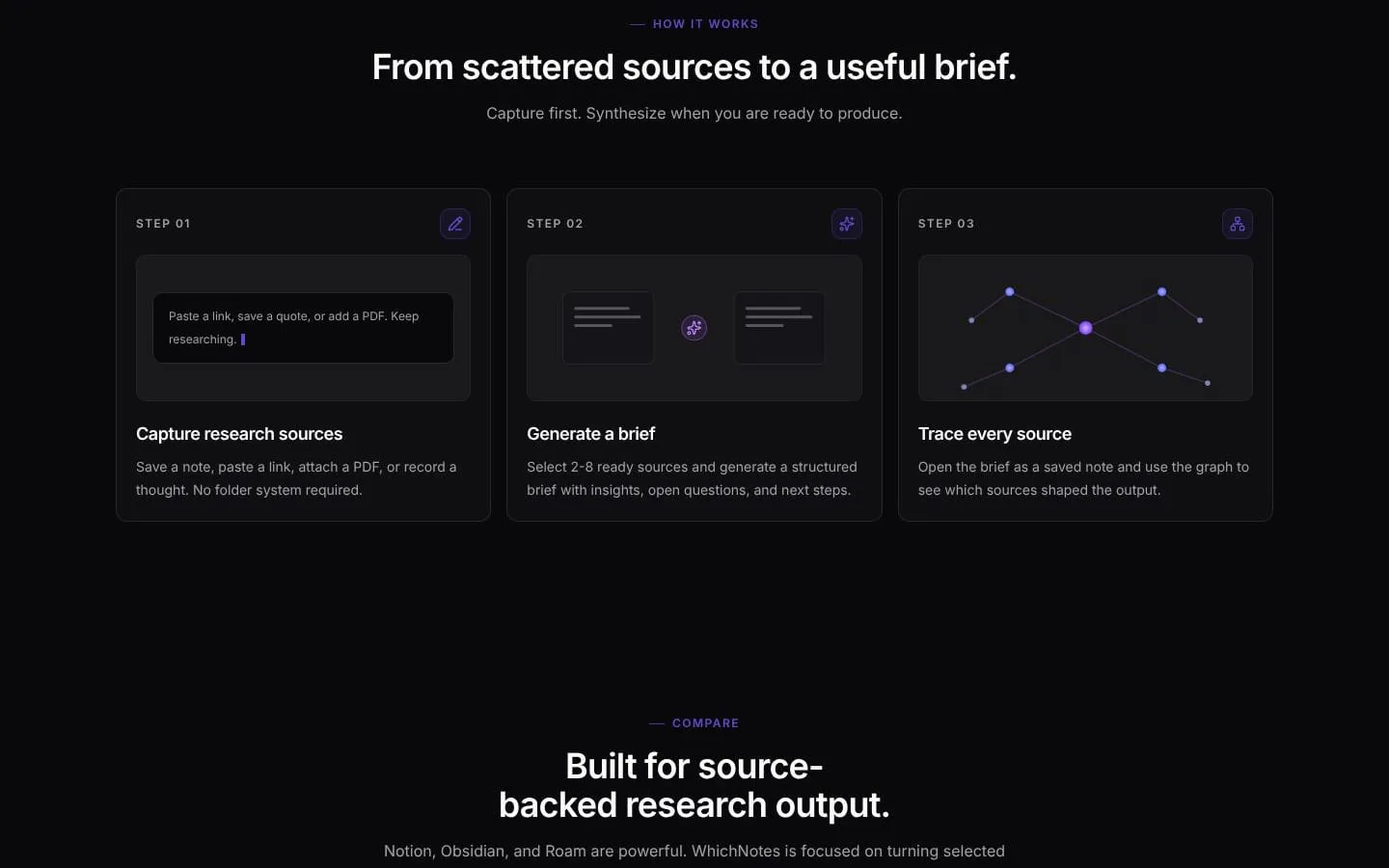
- Captures notes, links, PDFs, audio, and URL-based web pages; URL notes fetch and save page content with the original source URL.
- Result
- A research collection can be built from scattered inputs while retaining source attribution.
- Why
- Users can keep collecting material rather than designing a folder structure before beginning.
- Problem
- Raw saved material does not readily become usable writing or analysis.
- How it works
- Generates structured research briefs from 2–8 selected sources, including insights, open questions, and next steps.
- Result
- Users get a focused, reusable synthesis for writing, studying, analysis, or decisions.
- Why
- The product centers the brief as the primary output rather than leaving users to manually rewrite summaries.
- Problem
- Summaries can obscure the evidence that informed them.
- How it works
- Keeps source links visible and lets users trace a saved brief back to contributing sources.
- Result
- Users can revisit and verify the original research behind an output.
- Why
- Briefs are positioned as source-backed rather than detached AI output.
- Problem
- Related ideas across a growing note collection are hard to discover manually.
- How it works
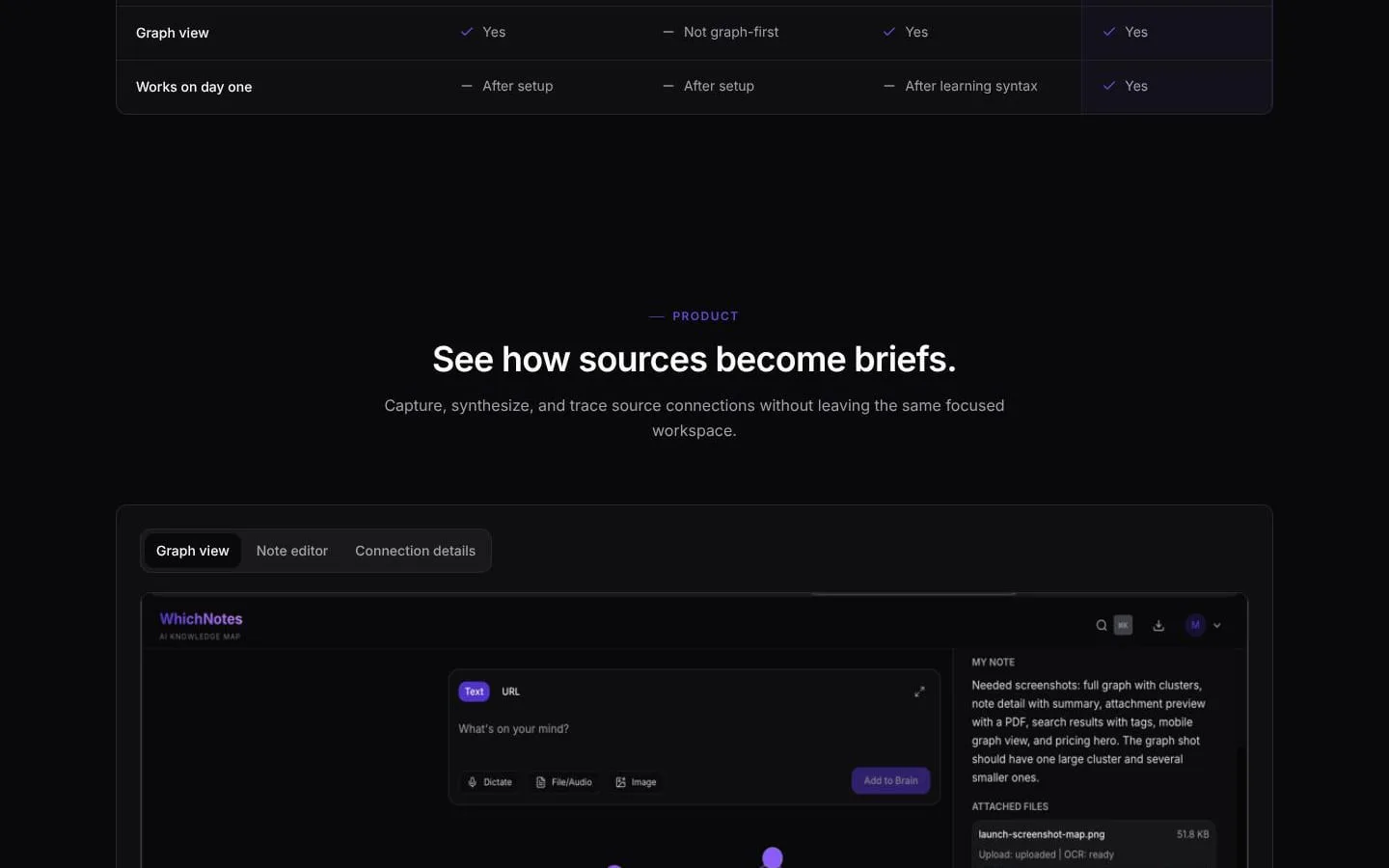
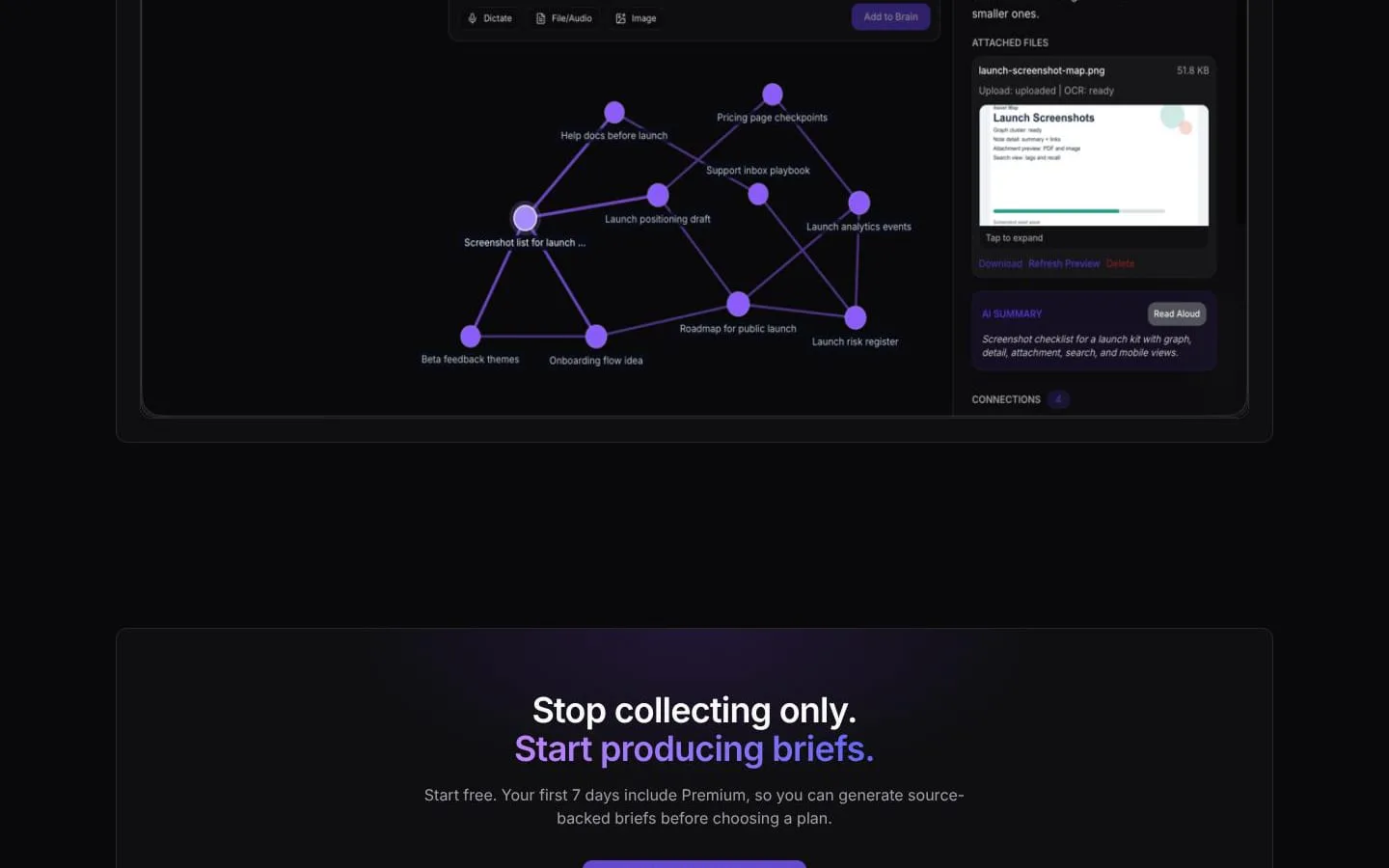
- Analyzes note content for themes, topics, and concepts; automatically creates explained connections based on similarity and visualizes them in graph view.
- Result
- Users can explore connected notes and discover related or previously forgotten ideas.
- Why
- Automatic connections surface relationships without requiring manual linking.
- Problem
- PDFs and recordings can remain outside the searchable research workflow.
- How it works
- Supports PDF, image, and audio attachments; extracts PDF text for AI analysis and full-text search, while audio attachments may be transcribed when transcription is available.
- Result
- Research stored in supported files can participate in retrieval and synthesis.
- Why
- Attachment content can contribute to topics, summaries, and connections.
- Problem
- Finding a specific item in a research collection can be slow.
- How it works
- Provides real-time, fuzzy full-text search with tag and note-type filters; results consider titles, content, tags, and AI-extracted topics.
- Result
- Users can locate notes, sources, topics, and tags more precisely.
- Why
- Search and filtering complement graph navigation for retrieval.
- Problem
- Users need control over their accumulated research data.
- How it works
- Imports WhichNotes JSON and plain text, and exports all notes, connections, tags, and metadata as JSON.
- Result
- Users can back up, analyze, or migrate their knowledge base.
- Why
- The product states that data can be moved freely and exported without restrictions.
What makes it different
- Living Briefs evolve with new sources while preserving version history
- Claims and answers remain traceable to their original sources
- Knowledge graph connections reveal related context automatically
- Uncertain AI suggestions stay under human review
- Personal and team research remain securely separated
Product questions
What does WhichNotes do?
WhichNotes is a personal research engine that captures links, notes, PDFs, audio, and web pages, then turns selected sources into source-backed research briefs.
Who is WhichNotes for?
Researchers, analysts, writers, students, and small research-heavy teams working across multiple sources.
How much does WhichNotes cost?
Free plan available. Personal Premium is $4.99/month. Teams are $4.99/seat/month with a 2-seat minimum. 7-day trial available.
Which platforms does WhichNotes support?
- Web
What can I use WhichNotes for?
- Competitor and market research
- Literature and academic research
- Product discovery and customer research
- Decision and investment memos
- Turning collected sources into evolving research briefs
What makes WhichNotes different?
- Living Briefs evolve with new sources while preserving version history
- Claims and answers remain traceable to their original sources
- Knowledge graph connections reveal related context automatically
- Uncertain AI suggestions stay under human review
- Personal and team research remain securely separated
Screenshots