AI
Rota Engine
Self-Hosted AI Gateway, Budget-Agent-MCP Governance & Security
- Category
- AI
- Stage
- Beta
- For
- Enterprise engineering, platform, security, and compliance teams operating LLM and AI-agent applications.
About
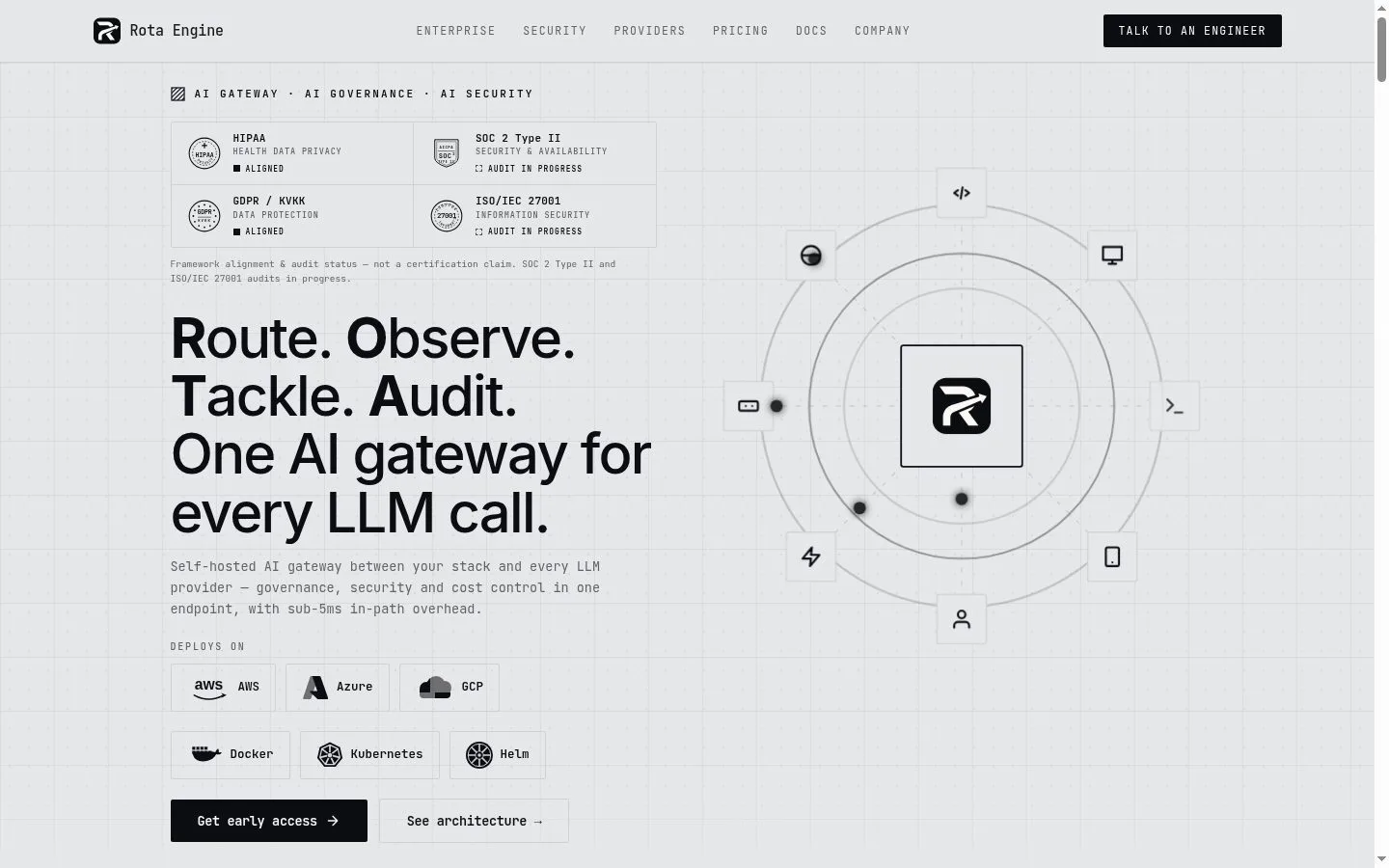
Rota Engine is the self-hosted enterprise AI gateway — route, secure, govern and audit every LLM and agent request in your VPC, with sub-50ms overhead.
Features
- Problem
- Applications are tightly coupled to individual model-provider APIs.
- How it works
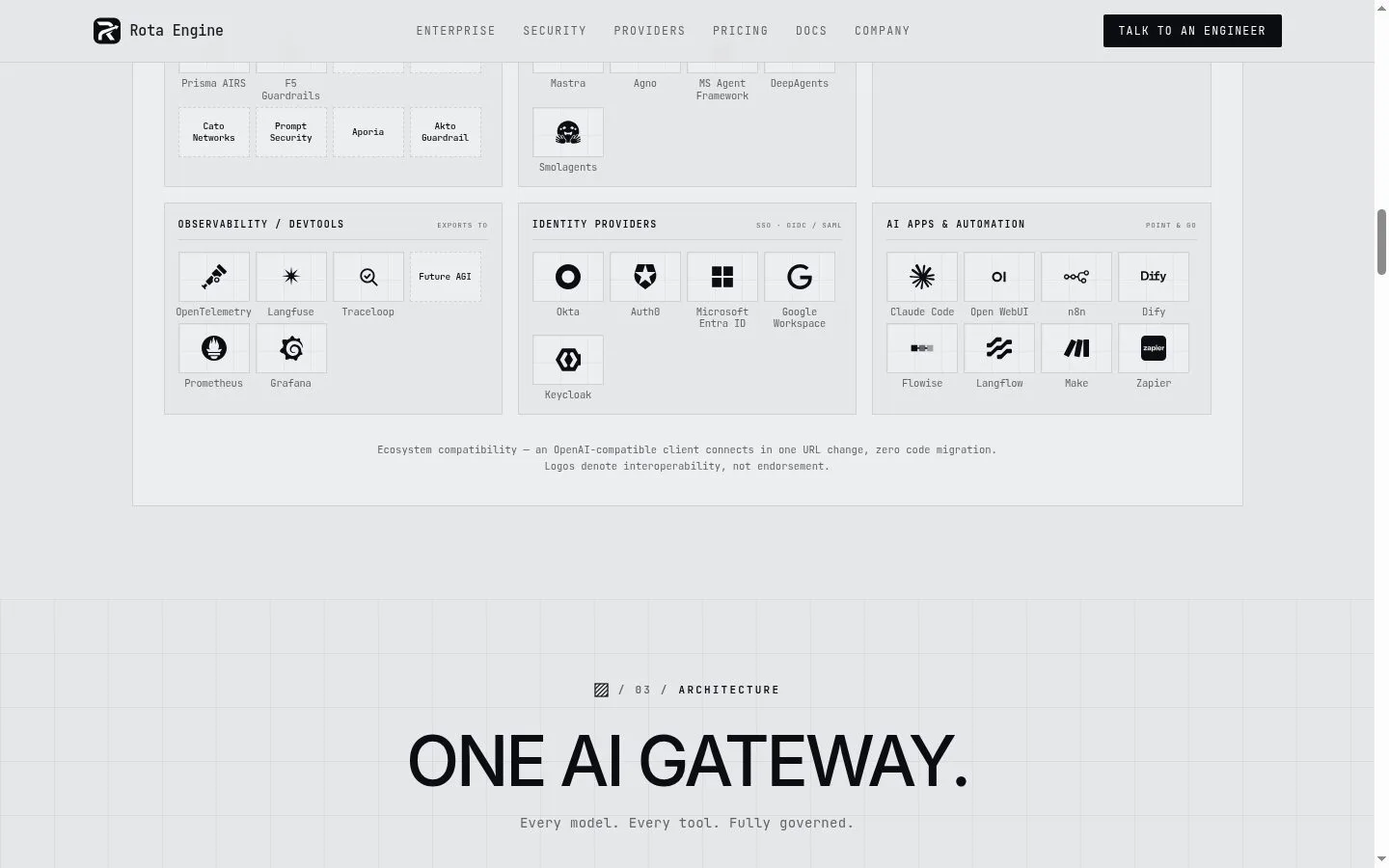
- Normalizes providers behind one OpenAI-compatible endpoint; existing SDKs can be pointed to the gateway with a base-URL change.
- Result
- Teams can route across providers without code migration.
- Why
- Provider selection and switching become configuration and model-string choices rather than application rewrites.
- Problem
- Untrusted prompts and model outputs can expose sensitive data or bypass policy.
- How it works
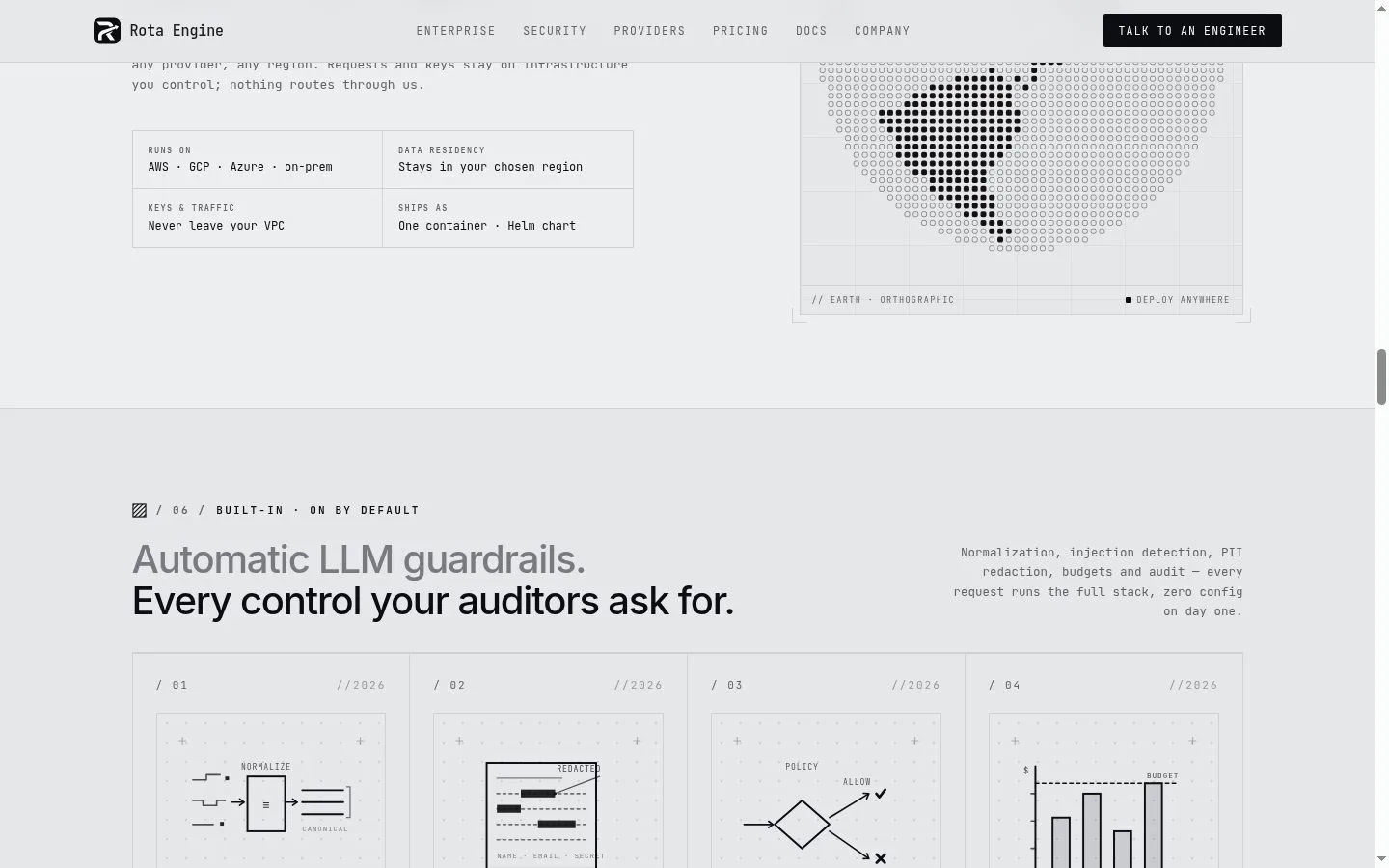
- Canonicalizes inputs, detects prompt injection, redacts PII and secrets, applies content policy, and performs output checks for grounding, leakage, and toxicity.
- Result
- A zero-trust guardrail layer protects AI traffic in the request path.
- Why
- Controls execute inline before requests reach models and before responses reach applications.
- Problem
- AI spend is difficult to attribute and constrain across teams and workloads.
- How it works
- Applies hierarchical quotas, hard caps, soft alerts, and cost attribution by team, app, key, tenant, and model.
- Result
- Organizations can measure and enforce AI spend before it becomes an invoice surprise.
- Why
- Budgets and routing rules are managed as policy rather than distributed application logic.
- Problem
- Provider degradation and outages interrupt AI applications.
- How it works
- Load-balances requests and uses health-aware model and provider fallback chains, including standby groups.
- Result
- Traffic can transparently reroute to healthy models or providers.
- Why
- Reliability decisions are applied centrally at the gateway.
- Problem
- Audit and compliance reviews lack a complete, trustworthy record of AI decisions.
- How it works
- Logs requests, redactions, and routing decisions in an immutable, cryptographic hash-linked chain and supports SIEM, S3, and warehouse export.
- Result
- Teams can provide auditable evidence instead of reconstructing activity from distributed logs.
- Why
- A centralized record makes each governed request replayable and exportable.
- Problem
- Sending prompts through a third-party gateway can conflict with residency and retention requirements.
- How it works
- Runs inside the customer VPC, cloud, datacenter, or on-premises environment, with zero retention by default.
- Result
- Teams retain control of data boundaries and deployment region.
- Why
- Prompts, keys, and traffic remain on infrastructure controlled by the customer.
Product questions
What does Rota Engine do?
Rota Engine is a self-hosted AI gateway and control plane that sits between applications or agents and LLM providers, centralizing routing, security controls, cost governance, observability, and audit trails through an OpenAI-compatible endpoint.
Who is Rota Engine for?
Enterprise engineering, platform, security, and compliance teams operating LLM and AI-agent applications.
Screenshots