Developer tools
Devora.js
security-first, multi-app web framework
- Category
- Developer tools
- Stage
- Beta
- For
- Web developers and teams building multiple related sites or apps that share a core and backend but may deploy independently.
About
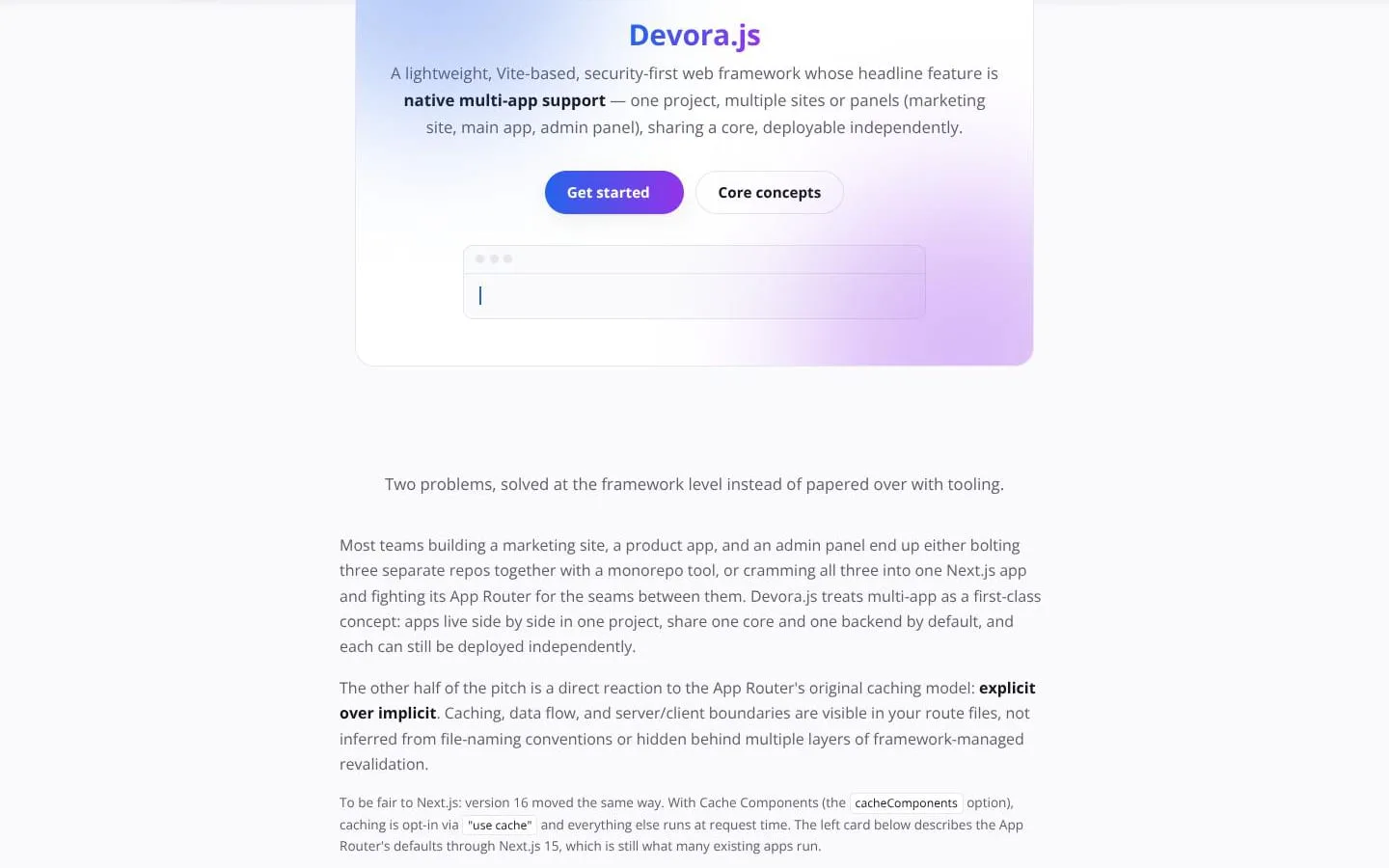
A lightweight, Vite-based web framework whose headline feature is native multi-app support — one project, multiple sites, sharing a core, deployable independently.
Features
- Problem
- Related sites and panels can become separate projects or require extra tooling to share code.
- How it works
- Registers multiple apps in one project, with shared core and backend by default; apps can be built and deployed independently.
- Result
- Teams can develop marketing sites, product apps, and admin panels side by side while retaining independent deployments.
- Why
- Multi-app architecture is a framework-level concept rather than an add-on monorepo workflow.
- Problem
- Implicit rendering and caching behavior can make data freshness and server/client boundaries difficult to understand.
- How it works
- Routes explicitly declare render modes and can export loaders, actions, and revalidation settings.
- Result
- Developers can choose per-route rendering and data behavior instead of relying on hidden defaults.
- Why
- Keeping these choices in route files makes framework behavior visible and intentional.
- Problem
- Security protections and session handling can otherwise require separate setup across apps.
- How it works
- Enables CSP and HSTS headers by default, and provides CSRF checks and revocable server-side sessions with cookie or Bearer transport.
- Result
- Apps start with security protections and can use shared, isolated, or disabled sessions as appropriate.
- Why
- Security is intended to be a framework default, with session scope configurable per app.
- Problem
- A framework-mandated database, ORM, or auth provider can constrain a project’s architecture.
- How it works
- Provides shared server functions and backend modules while allowing teams to supply their own database client and auth logic.
- Result
- Related apps can reuse backend logic while choosing their own data and identity integrations.
- Why
- The framework supplies backend structure and request primitives without prescribing those dependencies.
- Problem
- Hydrating an entire page can send client JavaScript for content that does not need it.
- How it works
- Supports five per-route render modes and lets individual components opt into island hydration.
- Result
- Pages can remain static HTML except for selected interactive components.
- Why
- Client-side behavior can be limited to components that need it.
Product questions
What does Devora.js do?
Devora.js is a lightweight, Vite-based web framework for building related sites and apps in one project. Apps can share core code, backend logic, and configured sessions while building and deploying independently.
Who is Devora.js for?
Web developers and teams building multiple related sites or apps that share a core and backend but may deploy independently.
Screenshots