Cloud infrastructure
Proxylity UDP Gateway
Serverless UDP infrastructure that routes packets directly to AWS services.
- Category
- Cloud infrastructure
- Stage
- Growth
- For
- Developers and teams building UDP-based services on AWS
- Pricing
- Free tier, then volume/usage based pricing. Enterprise pricing available for heavy workloads.
About
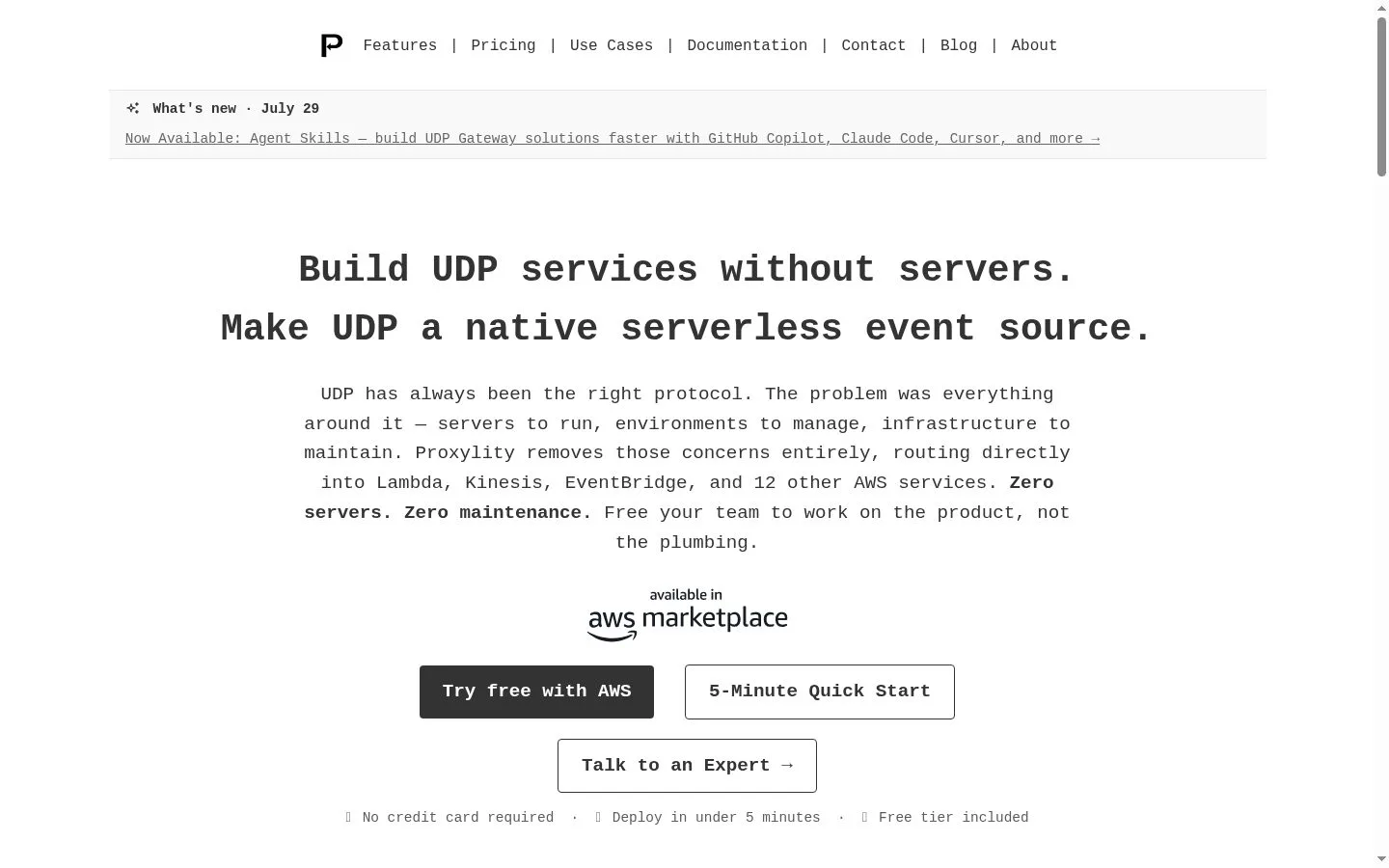
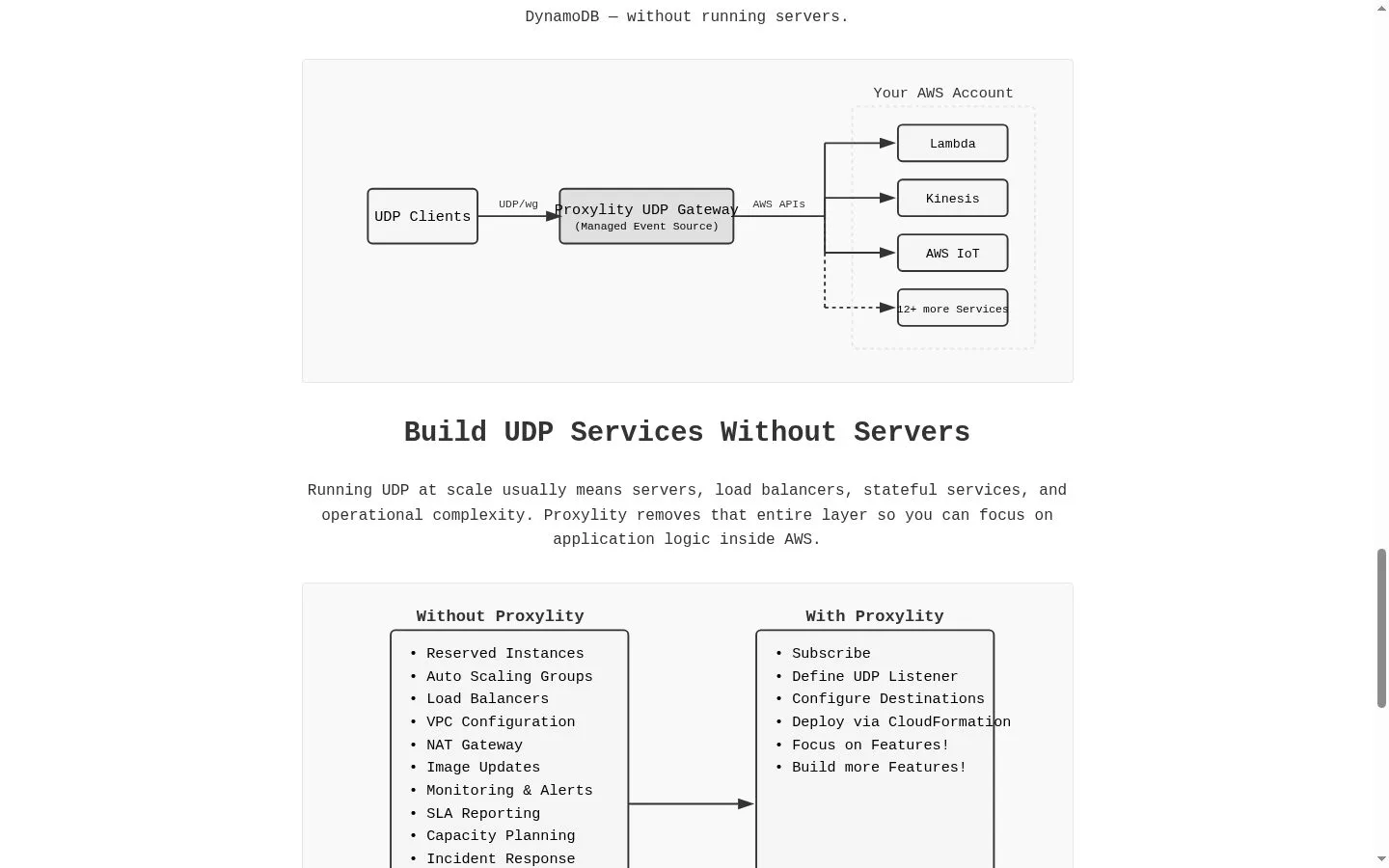
Build UDP services without servers. Route packets directly into Lambda, Kinesis, EventBridge, and 12 other AWS services. Zero servers. Zero maintenance. Deploy in under 5 minutes.
Use cases
- Telemetry Collection
- Internet of Things (IoT)
- Enterprise Modernization
- Game Backends
- Network Authentication Control
Features
- Problem
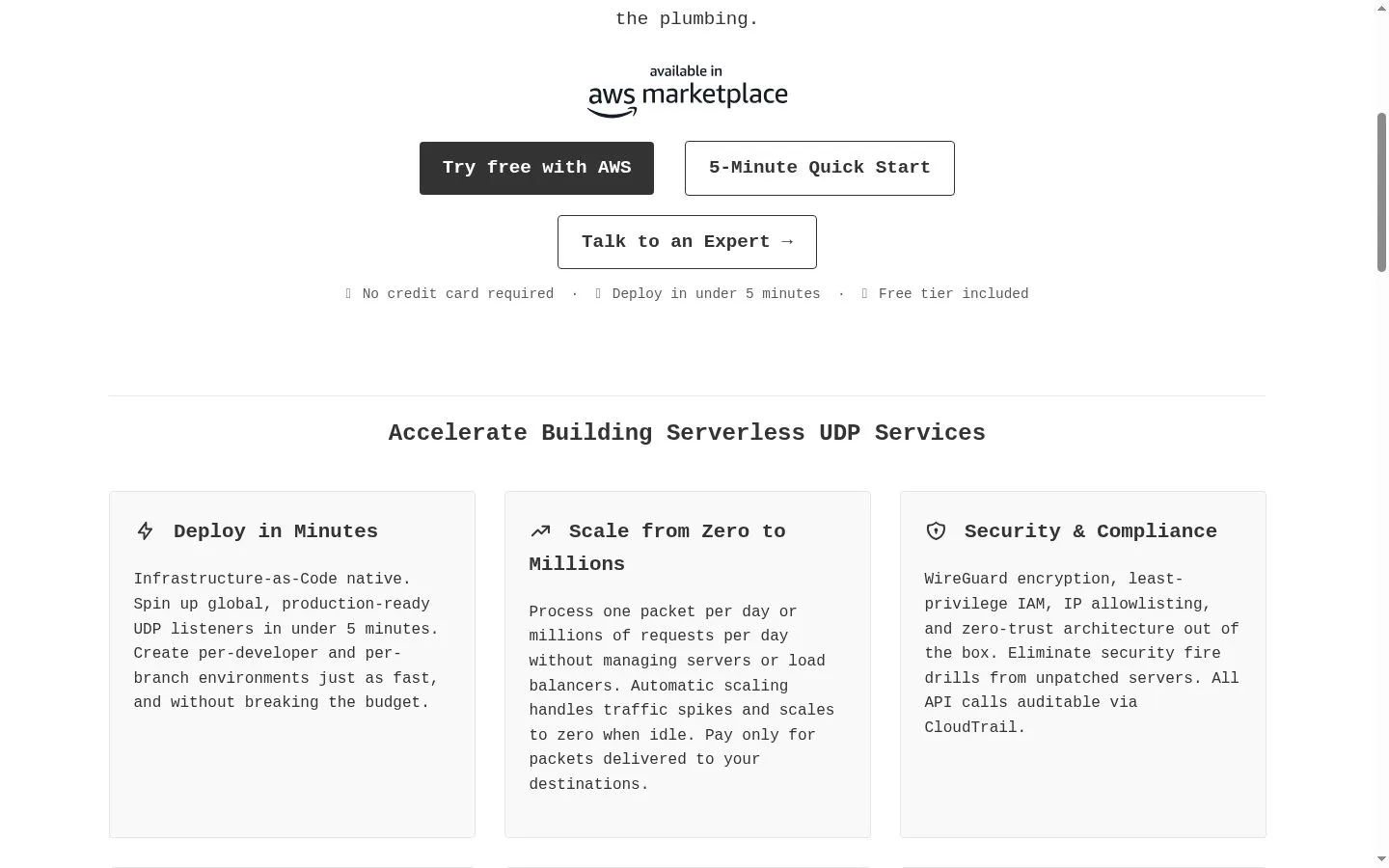
- UDP endpoints are typically deployed and maintained as server infrastructure.
- How it works
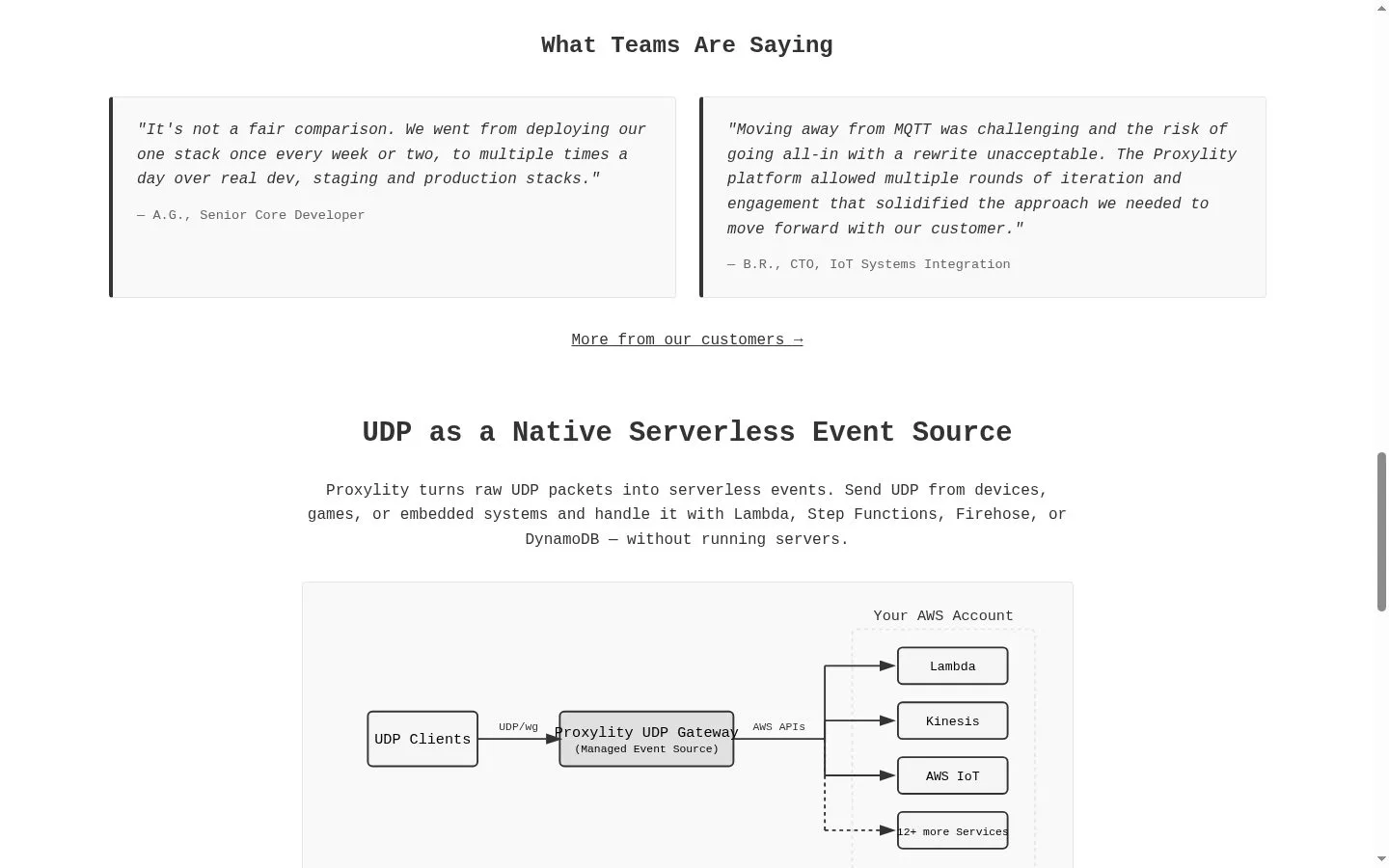
- Creates managed UDP listeners and routes packets directly to AWS serverless destinations.
- Result
- Teams can build UDP-backed applications while focusing on application logic.
- Why
- Removes the server, load balancer, and operational layer between UDP clients and AWS services.
- Problem
- Manual networking configuration makes repeatable deployments difficult.
- How it works
- Supports CloudFormation custom resources for listeners, destinations, client restrictions, and batching; an official Terraform module is also documented.
- Result
- Repeatable, version-controlled deployments and per-environment setups.
- Why
- Lets teams manage UDP infrastructure alongside application code.
- Problem
- Traffic volume can vary from idle to high throughput.
- How it works
- Automatically scales from zero and supports configurable batching by packet count, time window, or size.
- Result
- Cost-efficient packet delivery for both low-volume and high-throughput workloads.
- Why
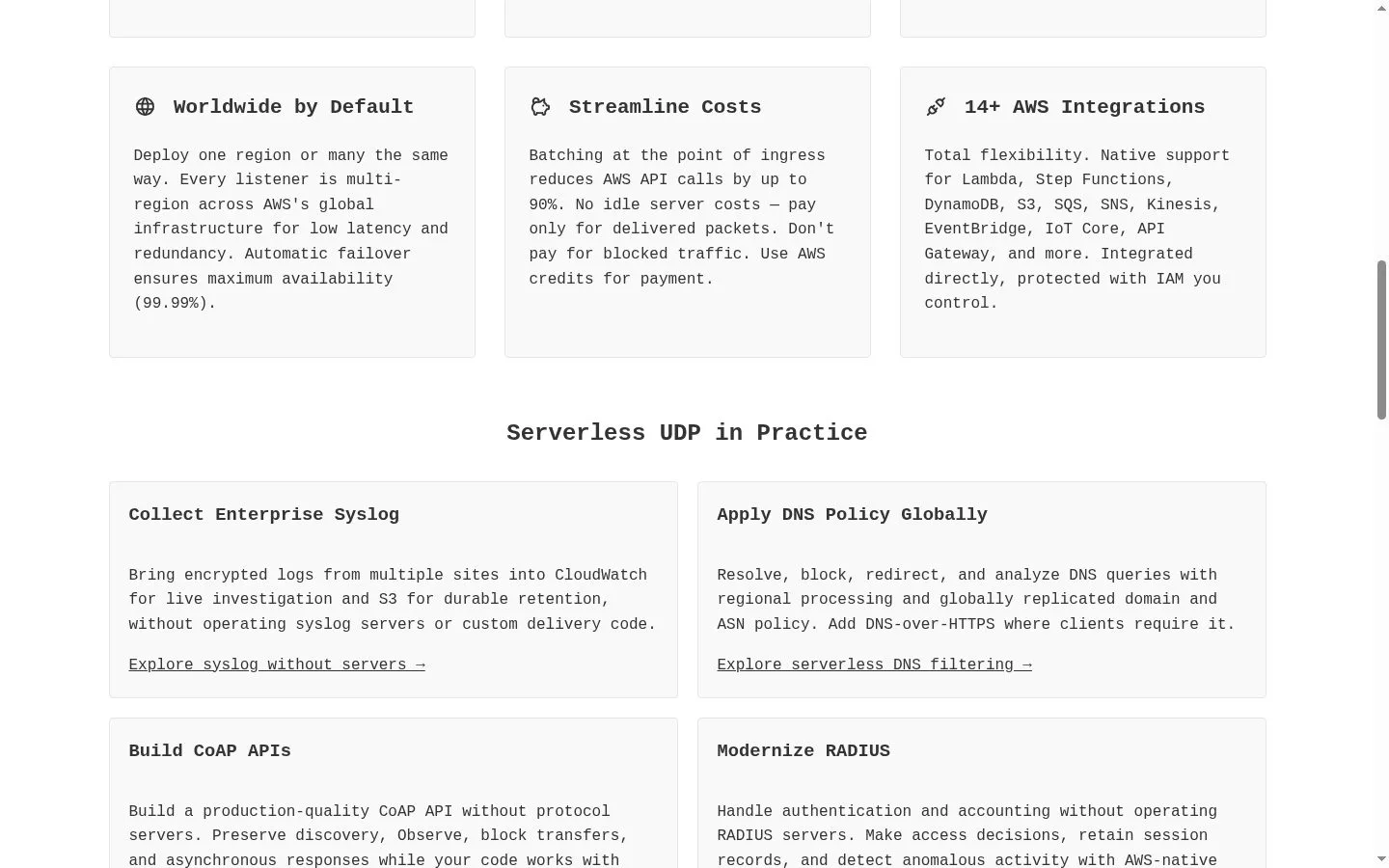
- Batching can reduce AWS API calls by up to 90% while allowing teams to tune latency and cost.
- Problem
- Global UDP delivery requires regional infrastructure and failure handling.
- How it works
- Provides multi-region listeners, automatic failover, and region-specific destination ARN maps that route to the closest configured destination region.
- Result
- Lower-latency, resilient global UDP services.
- Why
- Keeps ingress and processing closer to clients while avoiding custom multi-region networking code.
- Problem
- Exposing UDP services can create unauthorized-access and backend-abuse risks.
- How it works
- Provides CIDR allowlists, reverse-DNS domain restrictions, DNS-based Client Policy Framework rules, least-privilege IAM roles, and CloudTrail auditability.
- Result
- Controlled packet ingress and AWS-native, auditable delivery permissions.
- Why
- Access is controlled at the listener, while packet delivery uses roles scoped to each destination.
- Problem
- UDP workloads often need to integrate with existing event-driven AWS architectures.
- How it works
- Natively supports 14+ AWS services, including Lambda, Step Functions, EventBridge, IoT Core, DynamoDB, S3, Kinesis, SQS, SNS, and CloudWatch Logs.
- Result
- UDP can become an input to serverless workflows, storage, streaming, monitoring, and messaging.
- Why
- Packets can be delivered to services developers already use rather than requiring an additional message broker.
Why it is different
- Serverless, event-based architecture that costs almost nothing when idle and scales to the demands of global workloads when needed.
- Elite-level reliability.
Screenshots