AI
CLIMATE//ATLAS
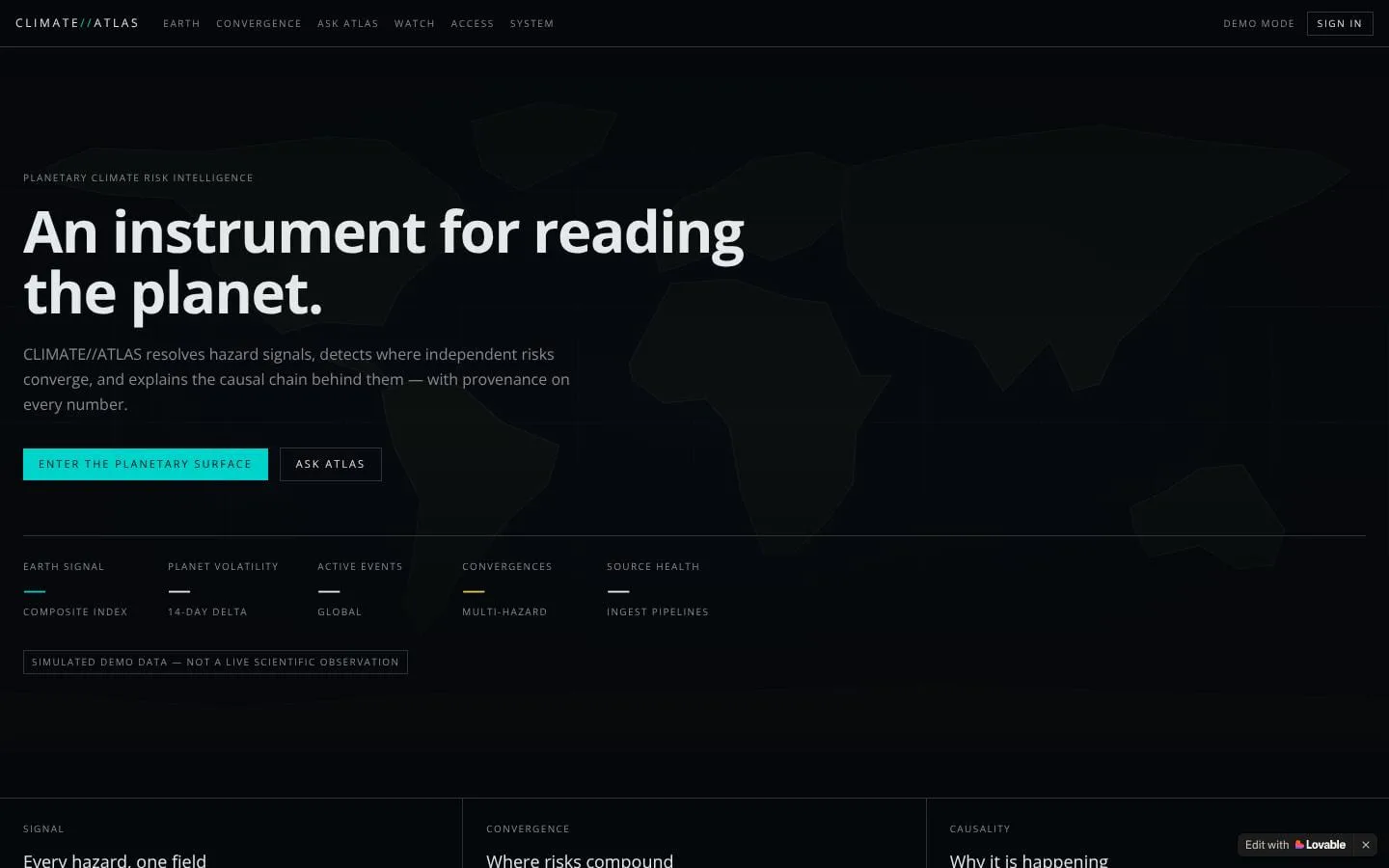
Planetary Climate Risk Intelligence
- Category
- AI
- Stage
- Beta
- For
- Climate risk analysts, researchers, and decision-makers monitoring multi-hazard risk.
About
Hazard signals, convergence detection and causal reasoning across Earth's climate systems.
Features
- Problem
- Hazard signals are spread across separate sources and formats.
- How it works
- Resolves fire, heat, drought, precipitation, cyclone, and ocean-heat signals onto one planetary surface.
- Result
- Users can inspect multi-hazard conditions in one place.
- Why
- A shared spatial view makes diverse hazard fields comparable.
- Problem
- Independent hazards can compound in the same region.
- How it works
- Scores overlapping hazard fields and tracks whether the convergence index is rising or easing.
- Result
- Users can identify where risk compounds.
- Why
- Overlapping fields indicate areas of multi-hazard risk.
- Problem
- Correlation alone does not explain climate risk.
- How it works
- Presents driver states and causal chains from ocean state to local risk.
- Result
- Users can examine why a local risk is occurring.
- Why
- The product positions causal pathways—not correlations—as the basis for explanation.
- Problem
- Climate questions need traceable evidence.
- How it works
- Ask Atlas investigations resolve to evidence, named sources, and explicit confidence.
- Result
- Users receive evidence-first investigation outputs.
- Why
- Atlas states that it does not override hazard and convergence engines.
- Problem
- Teams need ongoing monitoring rather than one-time analysis.
- How it works
- Paid access includes unlimited watchlists and alerts; institution access adds team workspaces and shared watch.
- Result
- Teams can monitor regions and share coverage.
- Why
- Standing surveillance is presented as an Analyst-tier capability.
- Problem
- Institutional users need programmatic and provenance-grade access.
- How it works
- Institution access includes Atlas API access and source-level provenance reporting.
- Result
- Organizations can integrate and document climate-risk intelligence.
- Why
- These are listed as Institution-tier capabilities.
Screenshots