Cloud infrastructure
Ark
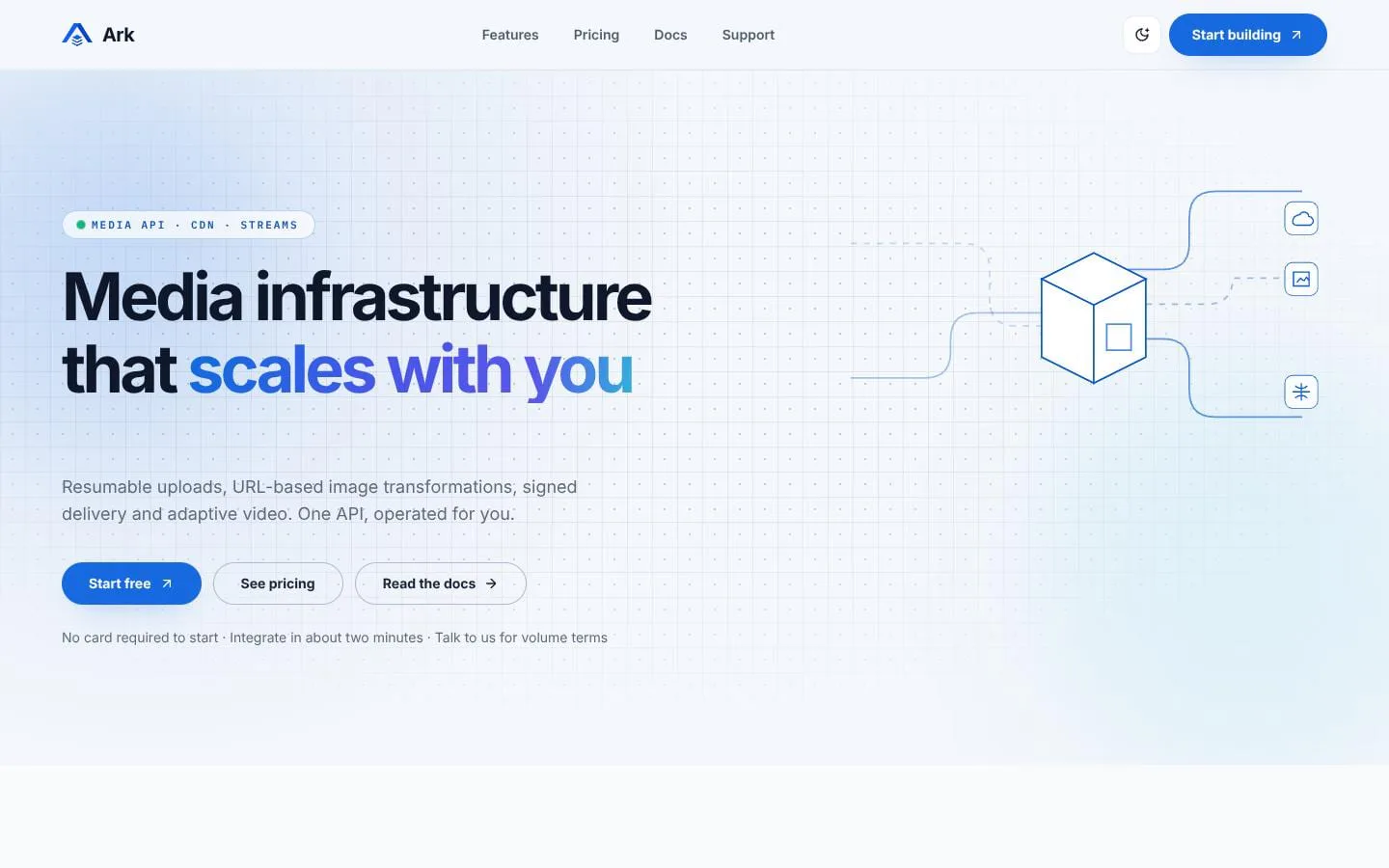
Fast, reliable cloud storage and media delivery for developers
- Category
- Cloud infrastructure
- Stage
- Beta
- For
- Engineering teams and developers building media-heavy applications
About
Ark gives engineering teams resumable uploads, URL-based image transformations, signed delivery, replicated storage and CDN delivery behind one API — with usage-based pricing you can predict.
Features
- Problem
- Large uploads fail or overload application servers.
- How it works
- Ark uses direct-to-storage single-part or multipart uploads on short-lived presigned URLs, with resume support and verification before an asset is available.
- Result
- Teams can support resilient browser and server uploads, including large files.
- Why
- Transfers can continue from the last completed part and do not route file bytes through the customer's API server.
- Problem
- Teams must generate and maintain many image variants.
- How it works
- Ark transforms media from delivery URLs, including resizing, format conversion, compression, thumbnails, WebP, and AVIF, while caching derivatives at the edge.
- Result
- Applications can deliver appropriately sized media without re-uploading or pre-processing every variant.
- Why
- A canonical original can serve on-demand variants rather than requiring a build-time processing pipeline.
- Problem
- Private media needs controlled access.
- How it works
- Ark offers scoped tokens, short-lived browser sessions, signed delivery URLs, and expiring signed download URLs.
- Result
- Teams can support browser uploads and private delivery without exposing permanent server credentials.
- Why
- Credentials and delivery access are separated by surface and scope.
- Problem
- Video playback requires encoding and streaming infrastructure.
- How it works
- Ark Streams accepts direct TUS uploads and produces adaptive renditions, an HLS manifest, poster frames, and signed playback.
- Result
- Teams can add adaptive video without building a dedicated video pipeline.
- Why
- Video processing and playback are operated through the same API and dashboard as other media.
- Problem
- Media delivery must remain fast and reliable at scale.
- How it works
- Assets are delivered through edge caching backed by replicated object storage on eligible plans, with range-request support and optional custom domains.
- Result
- Users receive efficient image and video delivery, including partial video fetches for scrubbing.
- Why
- The platform serves media near users and limits the impact of a single storage failure.
- Problem
- Media costs and operations can become opaque.
- How it works
- Ark exposes per-app storage, delivery, request usage, analytics, scheduled backups, retention, audit logging, and role-based team access according to plan.
- Result
- Owners can monitor consumption, govern access, and manage recovery with clearer operational controls.
- Why
- Teams need visibility and recovery controls before usage turns into an unexpected bill or an operational incident.
Screenshots