Developer tools
FetchSandbox
Test the integrations your AI wrote, without leaving your IDE
- Category
- Developer tools
- Stage
- Beta
- For
- Developers building API integrations with AI coding assistants
About
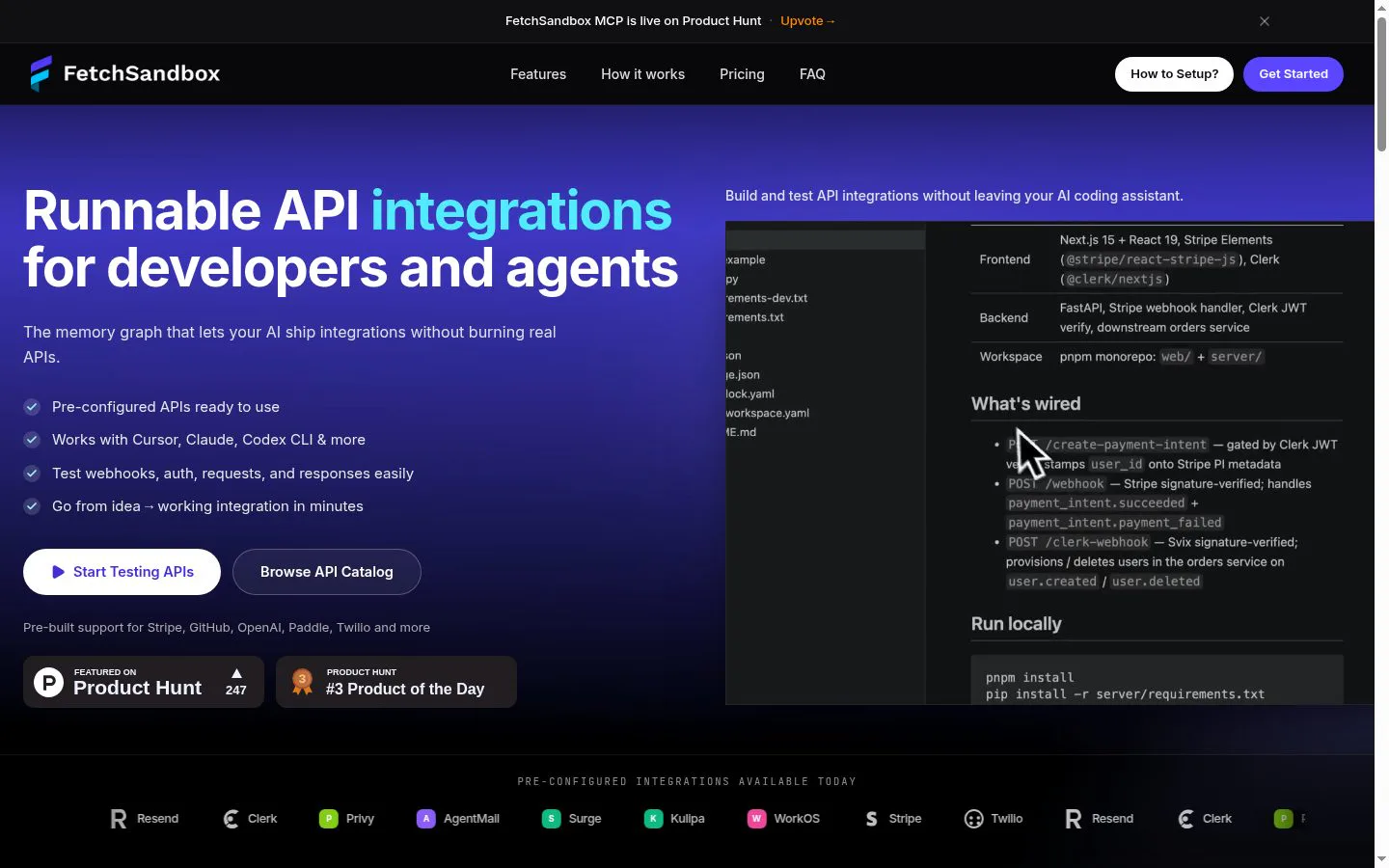
Ship your API integration in minutes, not months. Drop any OpenAPI spec and get docs, a stateful sandbox, workflows, and working code in 60 seconds.
Features
- Problem
- Developers need to test multi-step integrations rather than isolated endpoint responses.
- How it works
- Runs stateful API scenarios in which resources persist across requests and valid lifecycle transitions are enforced.
- Result
- Teams can validate real workflow behavior before deployment.
- Why
- A create-then-read or payment lifecycle flow requires state continuity to test integration logic meaningfully.
- Problem
- Webhook handlers often fail on retries, duplicates, out-of-order delivery, or state changes.
- How it works
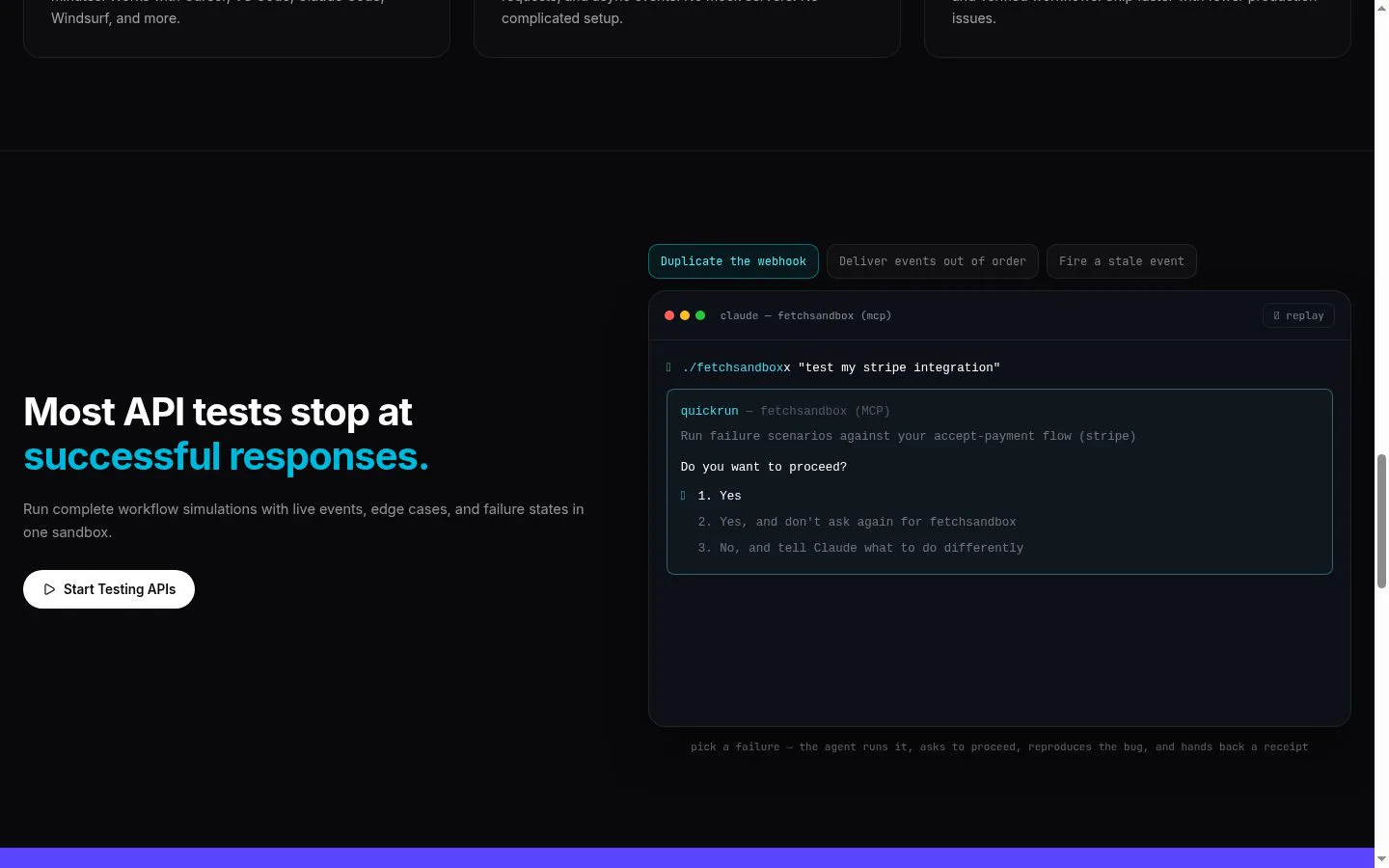
- Simulates webhook events on state transitions and supports webhook replay; landing-page examples include duplicate, out-of-order, and stale events.
- Result
- Developers can exercise webhook delivery and handler edge cases before production.
- Why
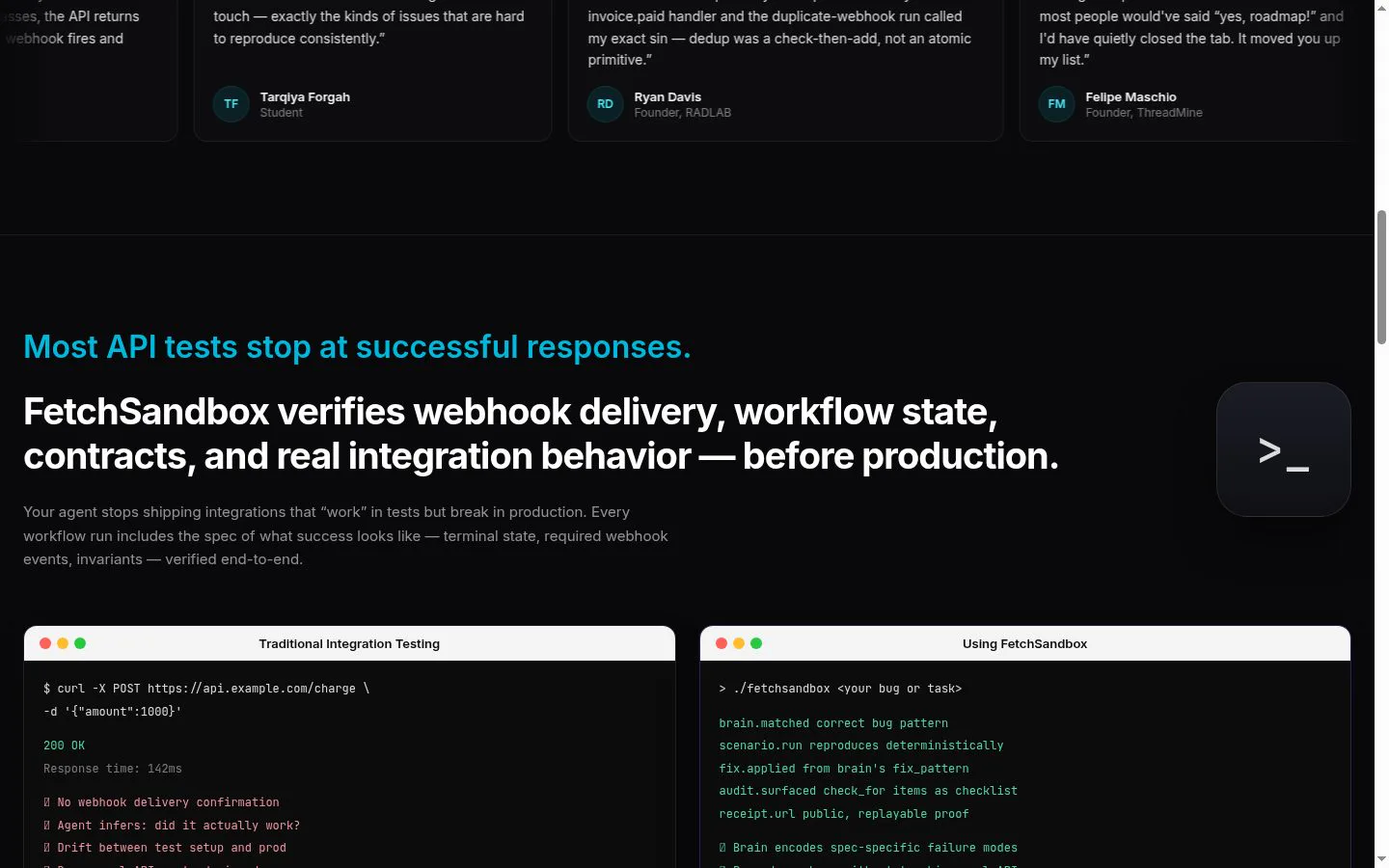
- A 200 response does not prove downstream event handling is correct.
- Problem
- AI coding assistants can write integrations without proving that fixes work.
- How it works
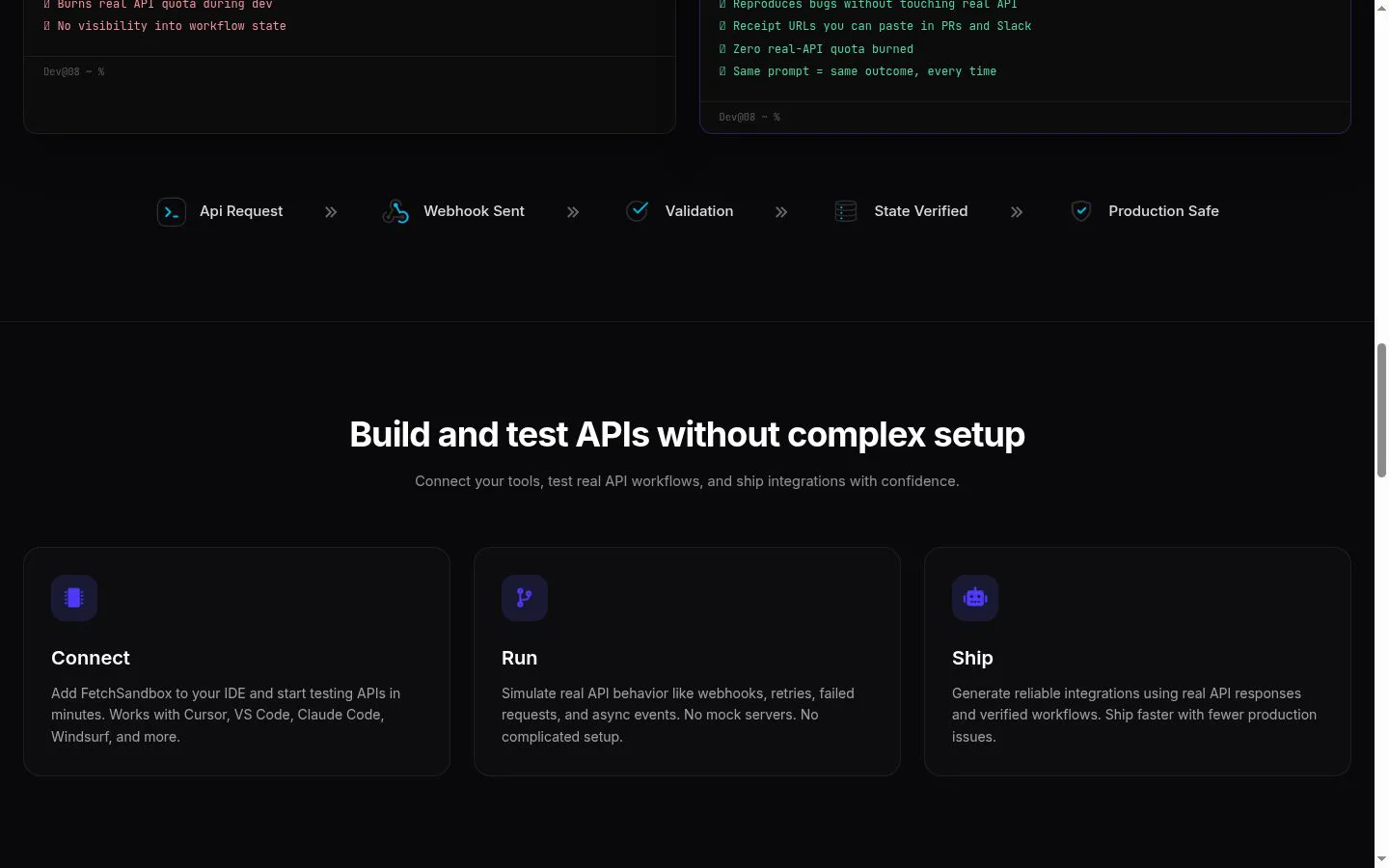
- Provides MCP and CLI access for running guided API workflows from IDE environments including Cursor, Claude Code, VS Code, and Windsurf.
- Result
- Agents can reproduce a scenario and return replayable proof of the run.
- Why
- Verification can run inside the agent and developer workflow rather than in a separate dashboard.
- Problem
- Testing against provider environments consumes credentials, quotas, and shared test data.
- How it works
- Offers isolated pre-configured API environments and supports OpenAPI 3.x imports without requiring real provider keys for core sandbox flows.
- Result
- Integration tests can run without real charges, API quota consumption, or shared-environment interference.
- Why
- Teams need to force failure paths without making real API calls or touching production data.
- Problem
- Teams need evidence of whether an end-to-end workflow met its intended contract.
- How it works
- Verifies declared terminal states, required webhook events, and invariants, and produces public, replayable receipt URLs.
- Result
- Developers can share a concrete record of integration proof in pull requests and Slack.
- Why
- Workflow success depends on more than a successful initial API response.
Product questions
What does FetchSandbox do?
FetchSandbox provides runnable, stateful API sandboxes that developers and AI coding agents can use from an IDE to build and test integrations before production.
Who is FetchSandbox for?
Developers building API integrations with AI coding assistants
Screenshots