Developer tools
o8
The open-source control room for coding agents.
- Category
- Developer tools
- Stage
- Beta
- For
- Developers and engineering teams coordinating multiple coding agents.
About
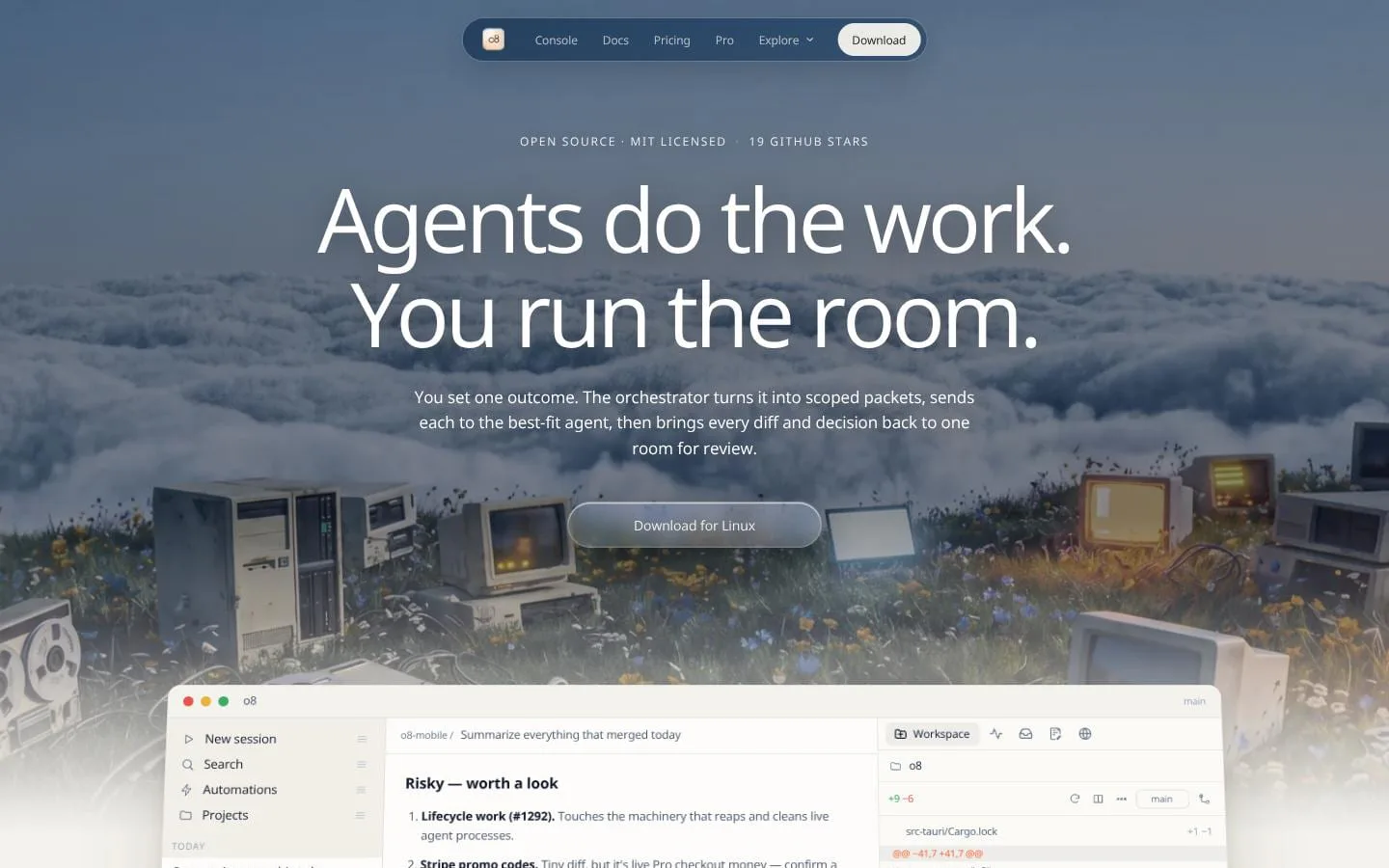
One conversation runs every coding agent you have installed through a governed control room. MIT licensed, local-first, and built to fork.
Features
- Problem
- A broad engineering goal is difficult to divide and coordinate across agents.
- How it works
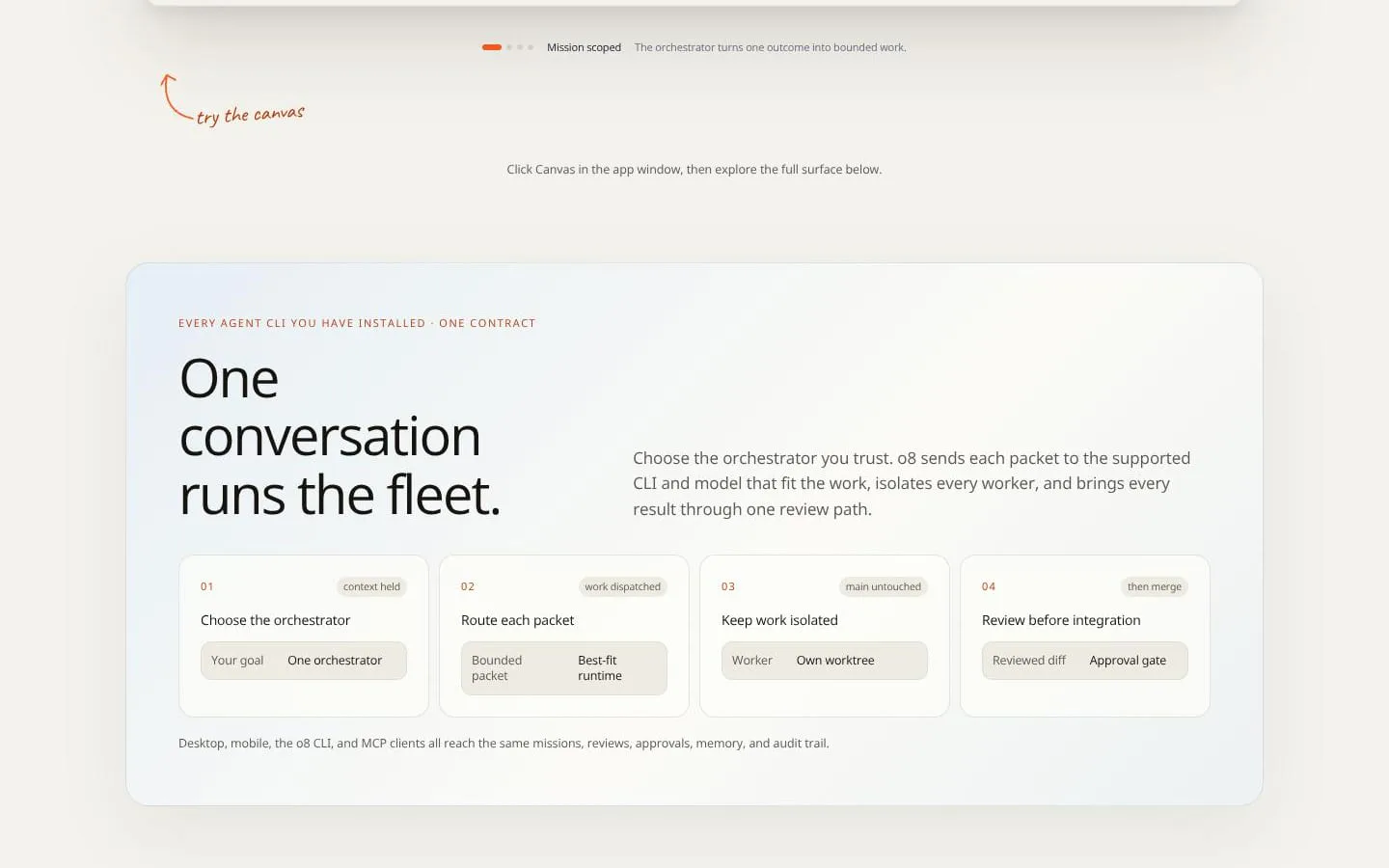
- The orchestrator creates dependency-ordered packets and dispatches independent work in parallel to best-fit runtimes.
- Result
- Teams can run a fleet from one conversation rather than manually coordinating each agent.
- Why
- Bounded packets make multi-agent work manageable while preserving one mission-level outcome.
- Problem
- Parallel agents can conflict with one another or affect the main branch prematurely.
- How it works
- Each worker operates in its own branch and git worktree; main remains untouched until review and integration.
- Result
- Parallel changes can be reviewed and merged with less interference.
- Why
- Isolation contains damage and supports concurrent work.
- Problem
- Agent-produced changes need accountable oversight.
- How it works
- o8 presents diffs, checks, reviewed-head status, approval controls, and an audit trail; risky work can receive a blind second review.
- Result
- Operators retain final authority over what ships.
- Why
- Review and operator approval remain separate gates before merge.
- Problem
- Engineering context is scattered across sessions, specs, and past decisions.
- How it works
- The Engineering Brain stores completed outcomes with repository context and returns cited answers; proposed durable directives require operator acceptance.
- Result
- Teams gain a queryable record of prior work and decisions.
- Why
- The fleet can reuse project knowledge without making unreviewed rules permanent.
- Problem
- Work artifacts are fragmented across terminals, browsers, files, media, and diffs.
- How it works
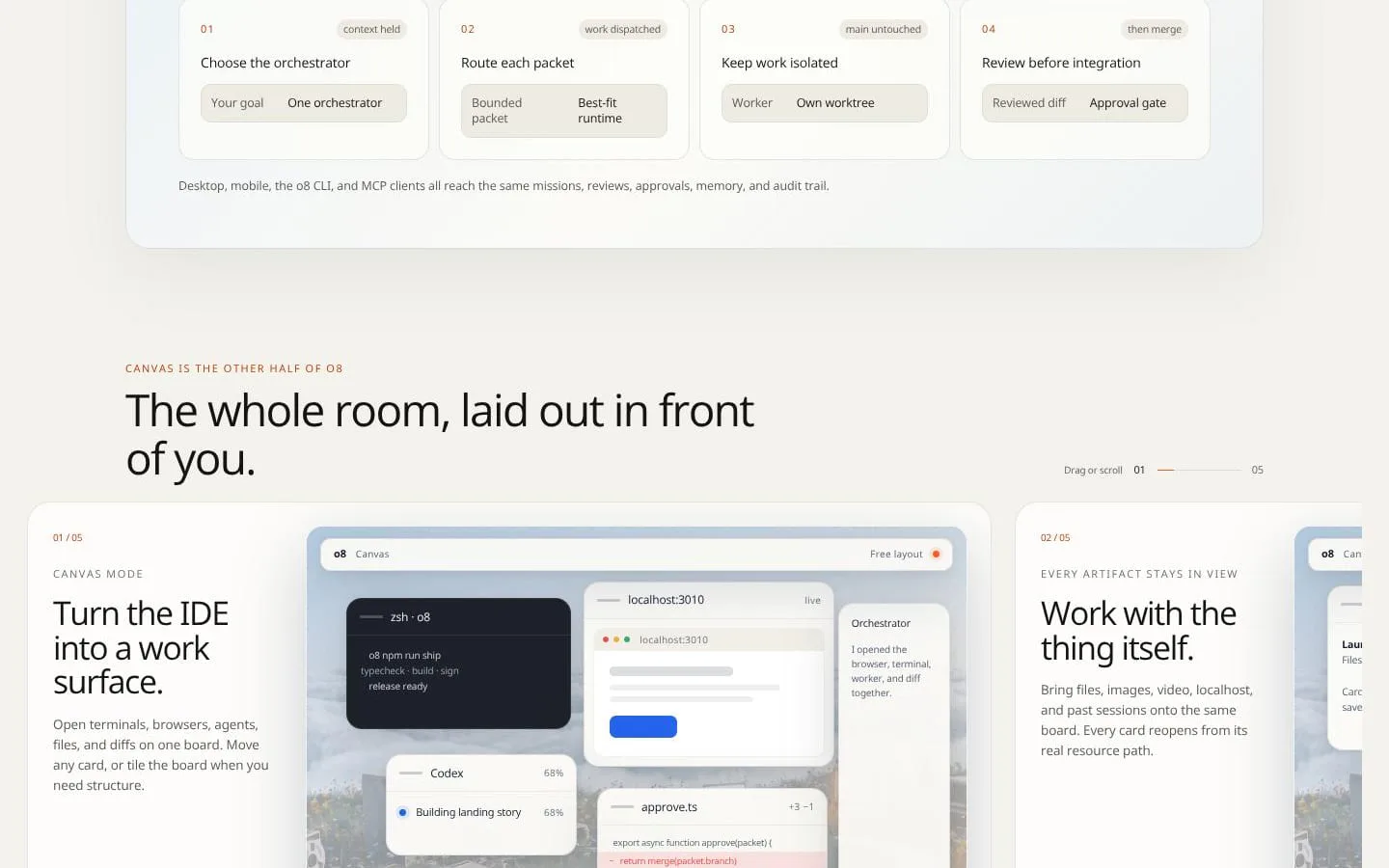
- Canvas places these resources on a draggable board, with free or grid layouts and resource-backed cards.
- Result
- Operators can inspect and arrange an active mission spatially.
- Why
- Evidence can remain adjacent to the work and decision it supports.
- Problem
- Operators need to act away from the desktop or through other interfaces.
- How it works
- Desktop, mobile, CLI, and MCP clients access the same missions, reviews, approvals, memory, and audit trail; Symon adds voice interaction.
- Result
- Teams can monitor, steer, and approve work from multiple governed surfaces.
- Why
- Every client follows the same governance path.
Screenshots