Education
Babel Nexus Index
Explore Public-Domain Classics as a Connected Map
- Category
- Education
- Stage
- Growth
- For
- Students, researchers, writers, and curious readers exploring public-domain classics.
About
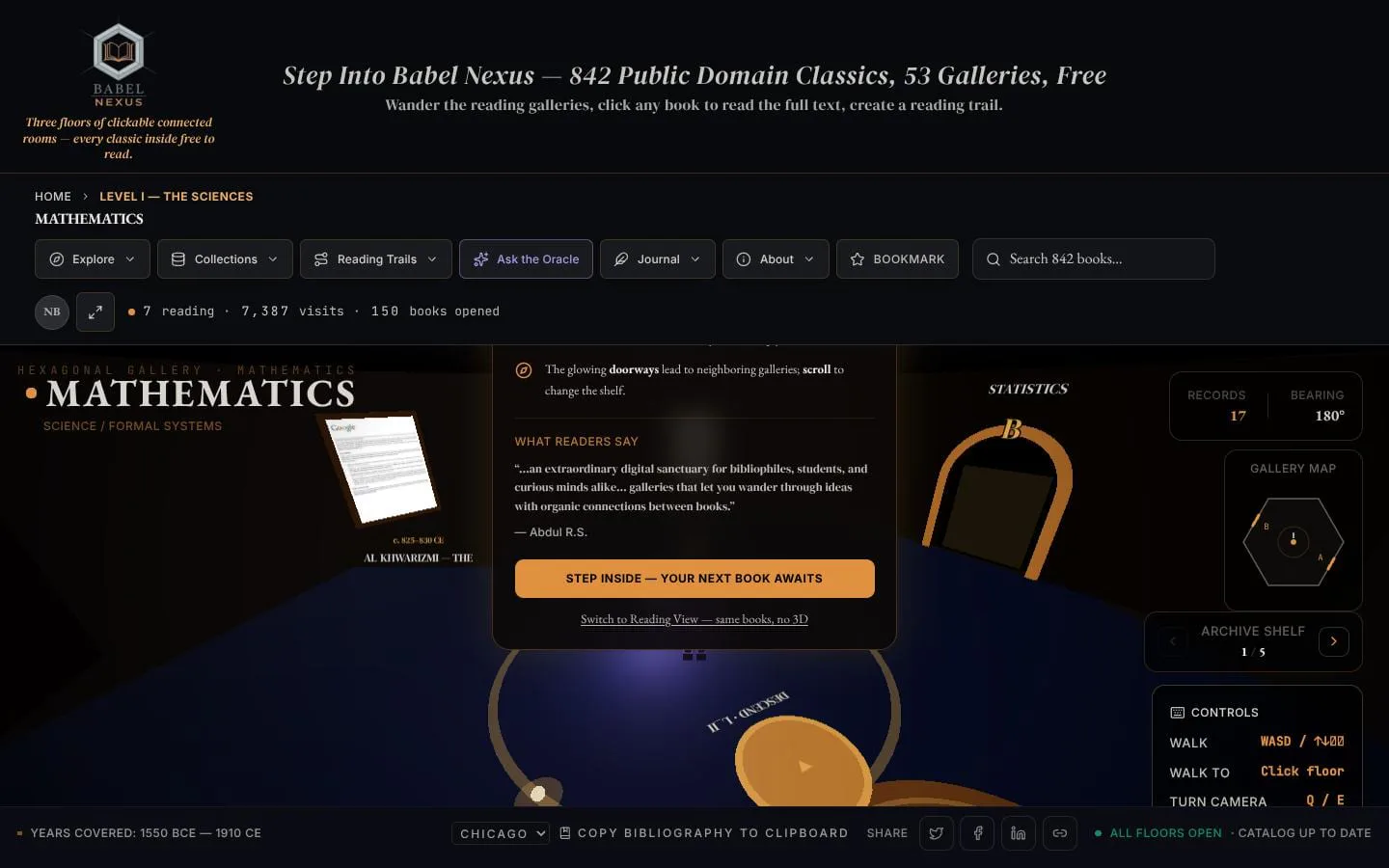
An interactive, browser-based knowledge-graph explorer for the public domain. It presents 53 hexagonal galleries across three floors (21 sciences, 24 literature, 8 wisdom) holding 837 public-domain primary works, connects them with associative trails after Vannevar Bush's Memex, and answers free-form questions through an AI Oracle powered by Google Gemini.
Features
- Problem
- Flat lists and search results obscure relationships between subjects.
- How it works
- Presents 53 hexagonal galleries connected by edges representing historical or conceptual relationships.
- Result
- More serendipitous, contextual discovery of related classics.
- Why
- Readers can follow the lineage between ideas instead of starting each search from scratch.
- Problem
- Readers need access to the source texts behind discovery records.
- How it works
- Opens works in an in-page reader using texts from Project Gutenberg, the Internet Archive, or Wikisource.
- Result
- Readers can move from discovery to free primary texts without an account.
- Why
- The Index is a discovery layer rather than a text host.
- Problem
- A broad collection can be hard to navigate at different levels of detail.
- How it works
- Offers a Visual Explorer, a whole-floor Cortex Map, direct gallery links, and filterable master booklists.
- Result
- The collection supports both exploratory and targeted research workflows.
- Why
- Users can enter through spatial browsing, an overview map, or a conventional list.
- Problem
- Users may need help tracing a question across many fields and books.
- How it works
- Provides the Nexus Oracle, a Gemini-powered assistant that reasons over the Archive map and points answers back to collection works.
- Result
- Readers receive archive-grounded starting points for cross-subject inquiry.
- Why
- It is restricted to the held collection rather than the open web.
- Problem
- Personal reading sequences are difficult to preserve and share.
- How it works
- Lets users build, name, and share ordered Reading Trails as a single URL.
- Result
- Users can create and circulate guided curricula or research journeys.
- Why
- Trails make associative paths through connected galleries reusable.
Product questions
What does Babel Nexus Index do?
Babel Nexus Index is a free visual discovery library for 842 public-domain classics, arranged across 53 connected subject galleries. Readers navigate a map of ideas, open full texts from source archives, ask a collection-grounded AI guide, and create shareable reading paths.
Who is Babel Nexus Index for?
Students, researchers, writers, and curious readers exploring public-domain classics.
Screenshots