Payments
RetryFix
Recover Failed Payments, Own-Domain Dunning
- Category
- Payments
- Stage
- Growth
- For
- Founders and operators of bootstrapped SaaS and other subscription businesses that use Stripe.
- Pricing
- Pay on recovery (10% of recovered revenue) or Flat rate (£49/month)
About
Automated failed-payment recovery and decline-aware dunning for Stripe subscription businesses.
Use cases
- Recover failed Stripe subscription payments
- Send decline-aware dunning emails
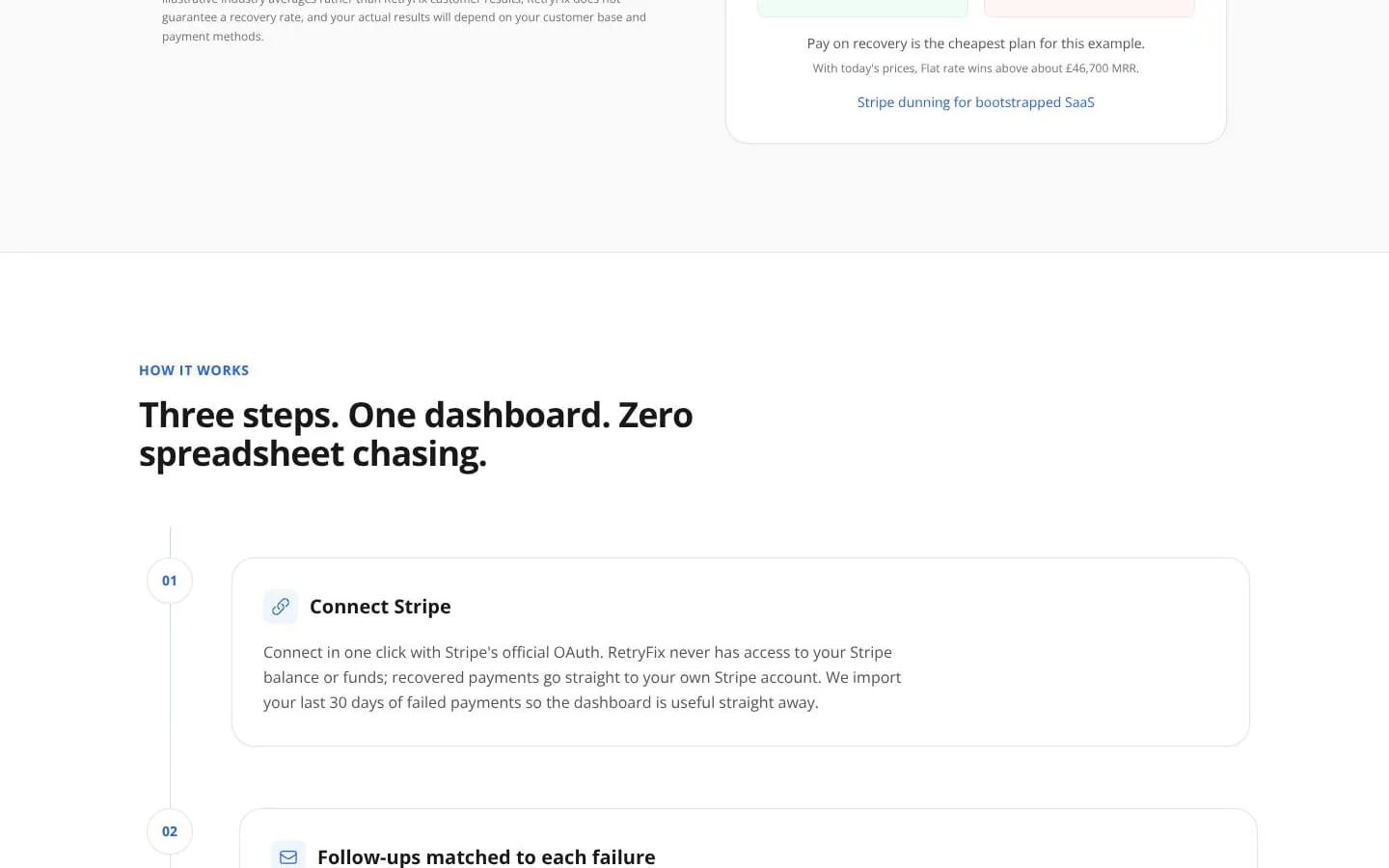
- Import the last 30 days of failed payments
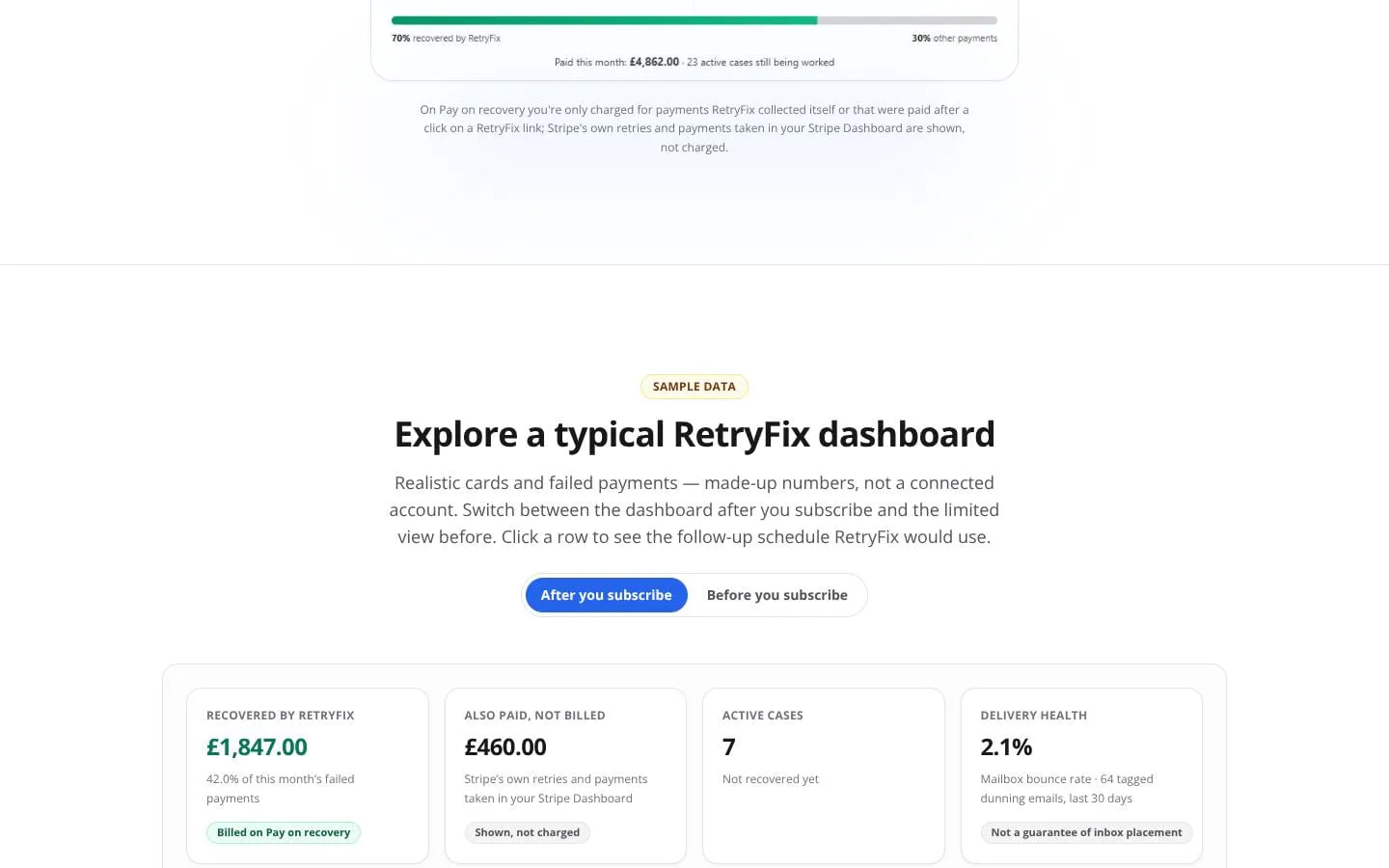
- See Recovered by RetryFix vs also paid another way
Features
- Problem
- Operators may not know how much recurring revenue is at risk from failed payments.
- How it works
- The demo connects to Stripe and shows the last 30 days of failed payments before any customer emails are sent.
- Result
- A clearer view of failed payments and potential recovery opportunities.
- Why
- Businesses can review their own payment failures before subscribing or contacting customers.
- Problem
- A generic retry or reminder may not suit every decline.
- How it works
- RetryFix selects a follow-up schedule based on invoice amount and decline reason, and adjusts email wording to the decline.
- Result
- Customers receive a relevant follow-up and secure Stripe payment link; unsuitable retry paths can be skipped.
- Why
- Some failures may respond to a retry, while others, such as an expired card, need customer action.
- Problem
- Third-party-looking payment emails may be less recognizable to customers.
- How it works
- Emails use the company name, or a verified business-owned subdomain after DNS setup. Each email identifies RetryFix as sending on the company’s behalf.
- Result
- Branded recovery emails, with own-domain sending available on both plans.
- Why
- A familiar sender can make recovery emails easier for customers to recognize.
- Problem
- Businesses need to distinguish recoveries from payments collected another way.
- How it works
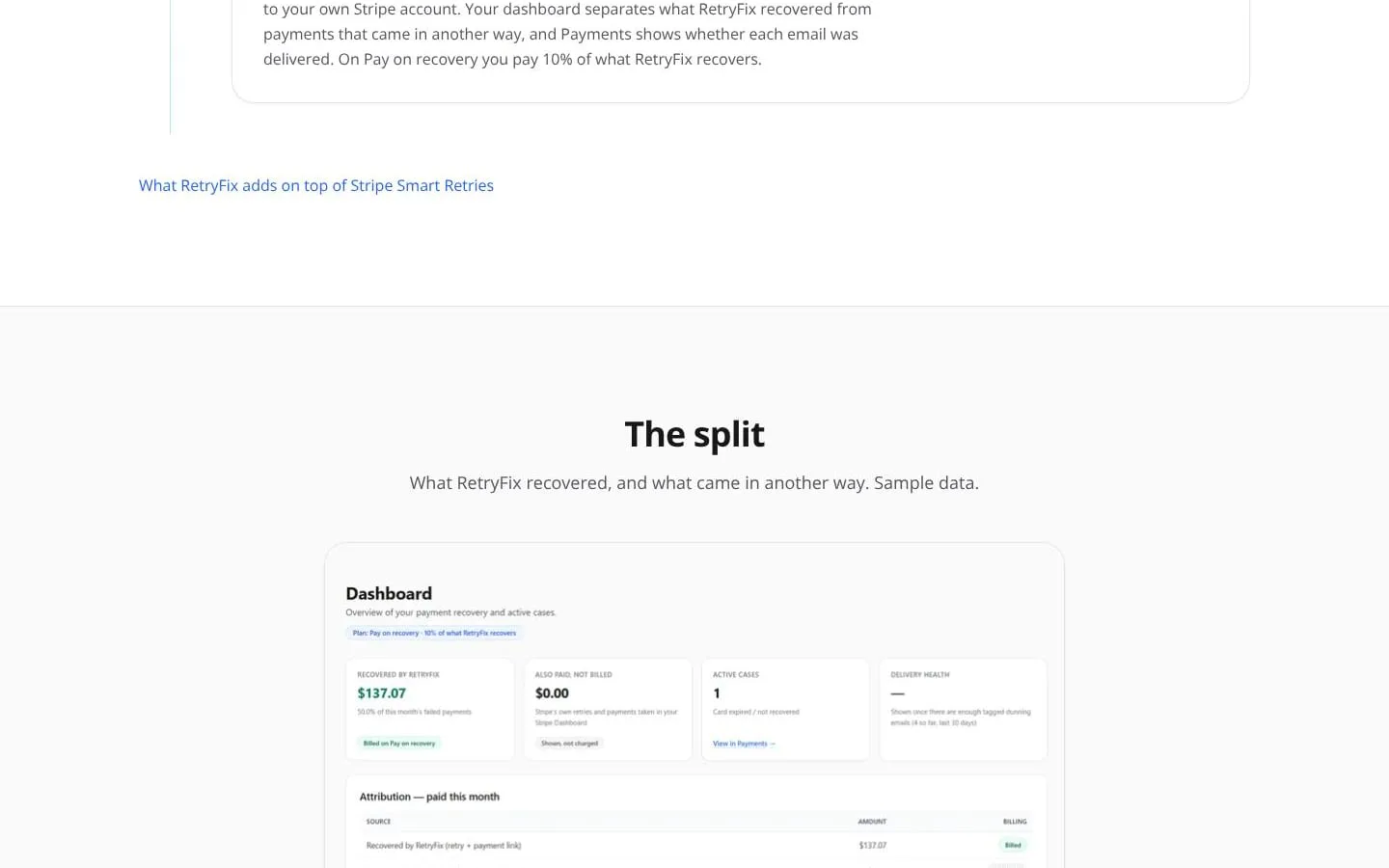
- The dashboard and Payments page show recovery attribution and email delivery; Stripe’s own retries and other payments are shown separately.
- Result
- A visible split between RetryFix recoveries and other payments, with money paid directly into the business’s Stripe account.
- Why
- On Pay on recovery, only RetryFix-attributed payments are charged.
- Problem
- Upfront software costs may be difficult for a bootstrapped business to justify.
- How it works
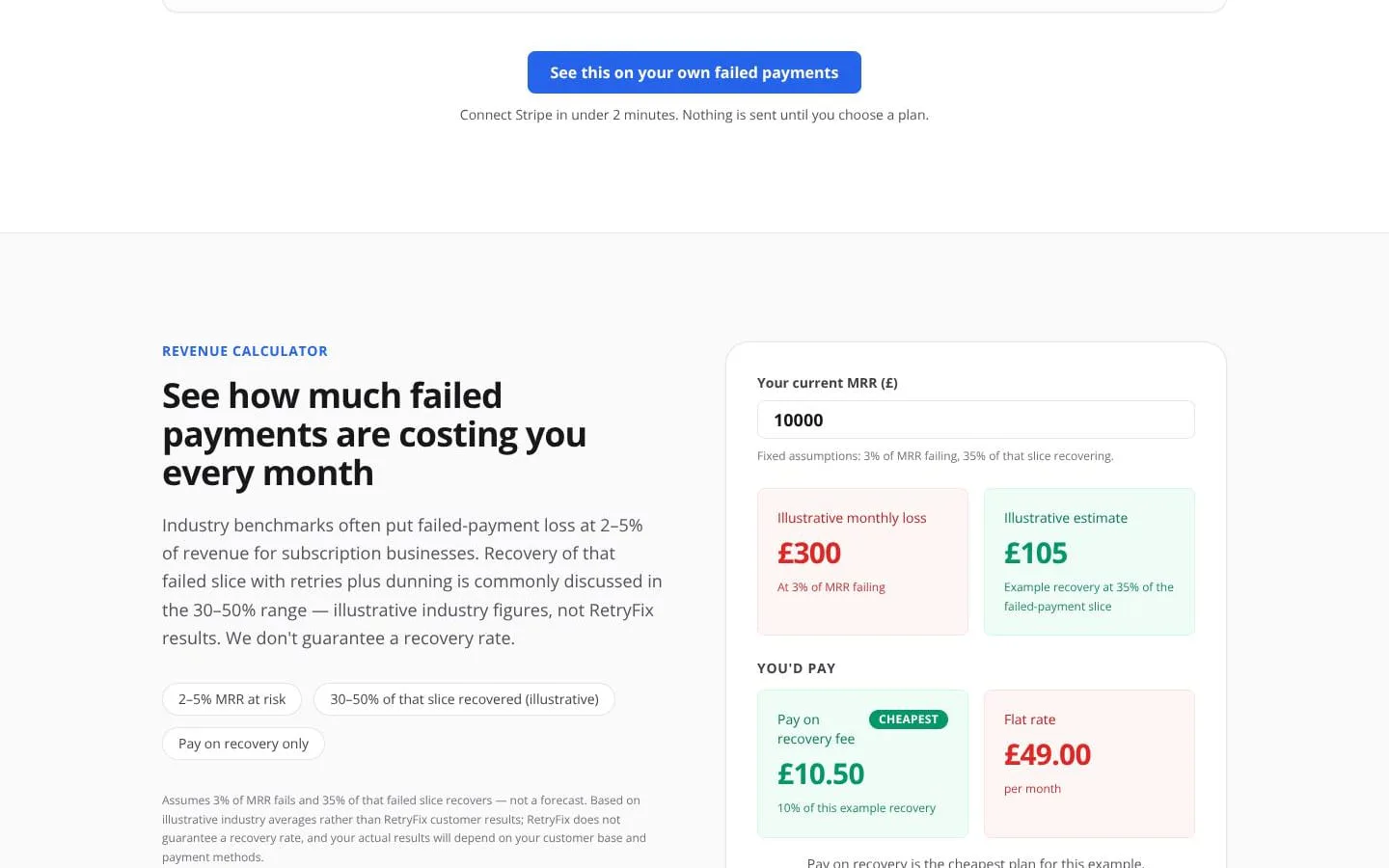
- Customers can choose 10% of RetryFix-attributed recoveries with no monthly fee, or a £49 monthly flat-rate plan.
- Result
- Businesses can select the pricing model that suits them; Pay on recovery has no percentage fee when RetryFix recovers nothing.
- Why
- The two plans offer a choice between a fee tied to recoveries and a fixed bill.
What makes it different
- Emails in your company name or from your own domain
- Follow-ups matched to the decline reason
- A recovered payment stops the rest of the sequence
- Dashboard splits RetryFix recoveries from other payments
- Pay 10% of what RetryFix recovers, or a flat £49 a month
- RetryFix never holds or moves your mo
Product questions
What does RetryFix do?
RetryFix helps Stripe subscription businesses recover failed payments with decline-aware follow-ups, secure Stripe payment links, and recovery tracking.
Who is RetryFix for?
Founders and operators of bootstrapped SaaS and other subscription businesses that use Stripe.
How much does RetryFix cost?
Pay on recovery (10% of recovered revenue) or Flat rate (£49/month)
What can I use RetryFix for?
- Recover failed Stripe subscription payments
- Send decline-aware dunning emails
- Import the last 30 days of failed payments
- See Recovered by RetryFix vs also paid another way
What makes RetryFix different?
- Emails in your company name or from your own domain
- Follow-ups matched to the decline reason
- A recovered payment stops the rest of the sequence
- Dashboard splits RetryFix recoveries from other payments
- Pay 10% of what RetryFix recovers, or a flat £49 a month
- RetryFix never holds or moves your mo
Screenshots